Income Tax Act 2025 & Draft IT Rules 2026 for Charitable institutions - Part 1
You can read the information below in over 15 languages! Simply use the translation tool in the top-left corner of the screen to select your preferred language, including অসমীয়া, বাংলা, ગુજરાતી, हिन्दी, ಕನ್ನಡ, മലയാളം, मराठी, মৈতৈলোন্, नेपाली, ଓଡ଼ିଆ, ਪੰਜਾਬੀ, संस्कृतम्, தமிழ், తెలుగు, and اُردُو.
Thank you Sharad from Saathi Development Services for sharing this resource with us.
Got questions about Income Tax for NGOs? Ask them on the forum, or browse other Income Tax related questions here.
Charitable purpose and Types of charitable institutions under income tax
Types of entities that can register as charitable institutions in India
For charitable purpose, the following entities can be constituted:
Society
Not for profit Company
While above entities have separate incorporation laws, the Income Tax law applies uniformly for all these entities.
Definition of Charitable purpose in Income Tax
Section 2(15) "charitable purpose" includes:
✓ Relief of the poor,✓ Education,✓ Yoga,✓ Medical relief,✓ Preservation of environment (including watersheds, forests and wildlife) and✓ Preservation of monuments or places or objects of artistic or historic interest, and✓ The advancement of any other object of general public utility:
Provided that the advancement of any other object of general public utility shall not be a charitable purpose, if it involves the carrying on of any activity in the nature of trade, commerce or business, or any activity of rendering any service in relation to any trade, commerce or business, for a cess or fee or any other consideration, irrespective of the nature of use or application, or retention, of the income from such activity, unless:
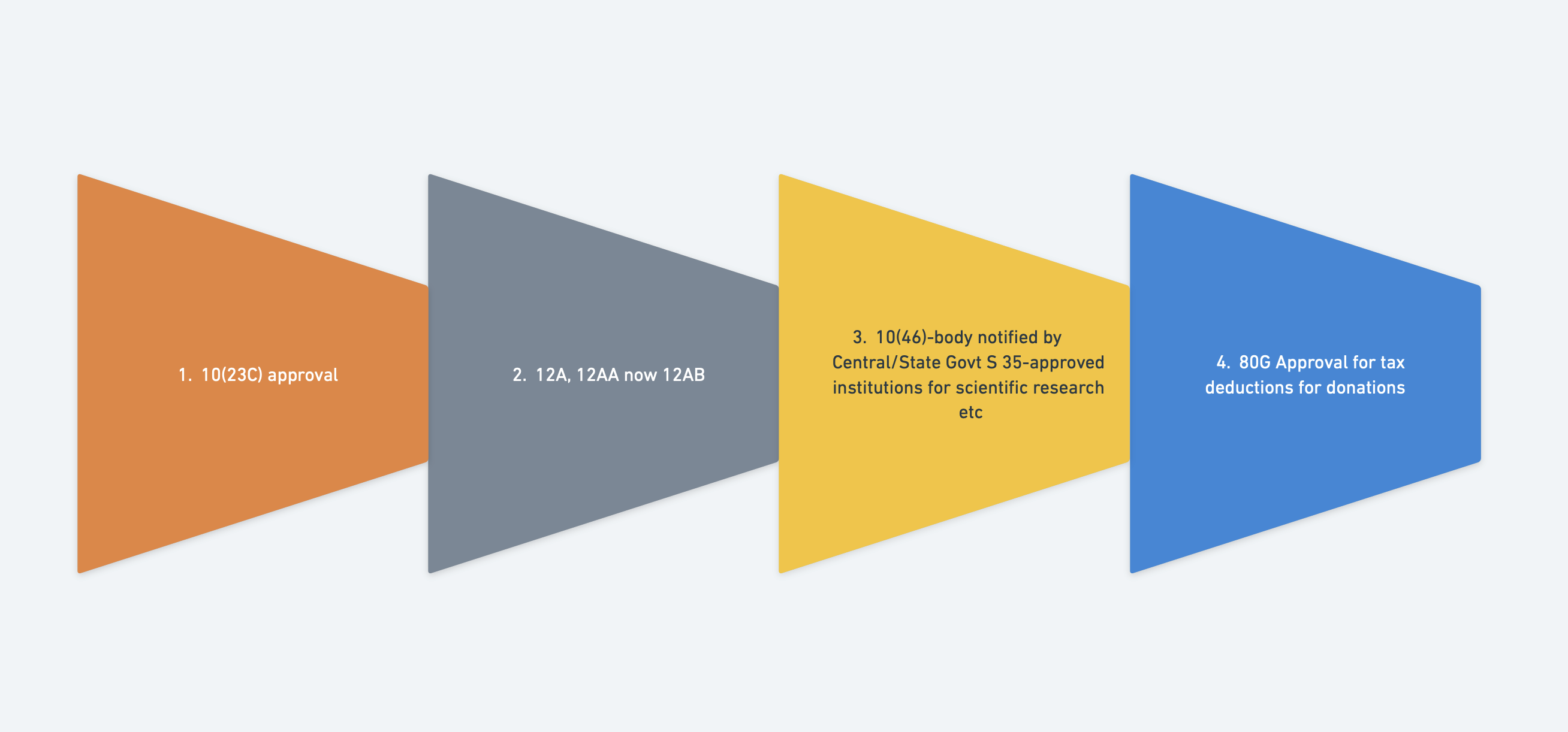
Illustrated:
- 10(23C) approval
- 12A, 12AA now 12AB
- 10(46)-body notified by Central/State Govt S 35-approved institutions for scientific research etc.
- 80G Approval for tax deductions for donations
Section 10(23C) entities
Section
Non Approval
Section
Approval
10(23C)(iiiab)
Educational institution wholly/substantially financed by Govt
10(23C)iv
National Fund/Charitable institution of national importance
10(23C)(iiiac)
Medical institution wholly/substantially financed by Govt
10(23C)v
Religious institution or religious cum charitable institution notified by Govt
10(23C)(iiiad)
Educational institution gross receipts less than Rs.5 cr in a FY
10(23C)vi
Educational institution gross receipts more than Rs. 5 cr in a FY
10(23C)(iiiae)
Medical institution gross receipts less than Rs.5 cr in a FY
10(23C)via
Medical institution gross receipts more than Rs.5 cr in a FY
2 recent Landmark SC judgements in October 2022
10 (23C)(vi) entities should be solely (exclusively) for educational purposes, can undertake business activity incidental to the main object but not otherwise. Can generate surplus in course of pursuing main objects
For GPU entities, commercial activity only for advancement of GPU. Markup has to be reasonable for such commercial activity. The commercial activity should not be feeding charity
New scheme of Registration-latest update
New regime of registration for charitable organisations wef 1.4.2021
Re-registration/approval of charitable entities u/s 10(23C), 12A,35 and 80G approval for a period of 5 years, thereafter renewal once every 5 years. Perpetual registration abolished.
Department wants to have database and better control/monitoring on charitable institutions which has been fragmented and decentralised until now
Types of Approvals:
Re-registration/Revalidation of existing registered entities-5 years
Provisional registration for new entities-3 years
Regular registration for existing unregistered entities-5 years
Provisional to Normal registration for new entities- Total period 5 years
Modification of objects clause for 12A entities
If registered both under 10(23C) or 10(46) and 12A, then retain 10(23C) or 10(46) for 5 years
Renewal of registration after 5 years
New Regime and Forms
Coverage:
Re registration/re approval under 10(23C)/12A/80G-existing registered
Registration/re approval under 10(23C)/12A/80G-existing un-registered
Provisional registration under 10(23C)/12A/80G-new entities
Statement of donation u/s 80G
Receipt/Certificate of donation u/s 80G
Forms:
10A-Re-registration and provisional registration
10AC-Approval of 10A by CIT
10AB-Registration of existing unregistered entities, conversion of provisional to normal registration, Renewal, change in objects and one of the two registrations made inoperative.
10AD- Approval of 10AB by CIT
10BD-Statement of donations u/s 80G
10BE-Receipt of donation u/s 80G
Action for existing registered entities
Common Form 10A for 10(23C), 12AA, 80G, 35 entities-select code for respective sections e.g. 01 for 12A and 11 for 80G.
CIT order within 6 (earlier 3) months from end of quarter in 10AC Form. Registration valid for 5years. No inquiry, instantly granted.
Upto 30.6.2024, condonation of delay was granted through CBDT circulars from time to time.
Renewal of 12AB registration and 80G approval of existing registered entities
Action for Provisional 12Ab Registration & 80G approval
Accreted Income or Exit Tax-Section 115TD of IT Act (1.6.2016)
Merger of charities with same/similar objects-new section 12AC specifying situationsof merger when accreted tax will not be applicable effective 1.4.2025
Department’s power to cancel registration
Power to cancel registration for Specified Violations i.e.
Reference by AO to CIT/PCIT who shall pass order within 6 months from quarter in which notice was issued.
Conditions of registration as per 10AC-12AB
Conditions of registration as per 10AC-80G
Anonymous donation-Section 115BBC of IT Act
Section 80G:
Statement of donation
Section 80G approval can be applied even if charitable status benefit taken which was not allowed earlier-effective 1.10.2024
Receipt/certificate of donation
Form 10BE
31st May for previous financial year
Linked to UIN of donor
Penalty for delay
Generation and download of donation receipt from web portal after filing 10BD
Issue the system generated 10BE to donor for claiming 80G benefit.
Code of Taxation for Charitable Institutions
Chapter III-Incomes which do not form part of total income
1.
Section 11
Income from property held under trust for charitable or religious purposes.
2.
Section 12
Income of trusts or institutions from voluntary contributions for charitable and relgious purposes.
Section 12A – Conditions for applicability of sections 11 and 12
Section 12AA – Procedure for Registration-repealed
Section 12AB – Procedure for Registration under new regime
3.
Section 13
Section 11 not to apply in certain cases.
Section 11
Income from property held for charitable or religious purposes
Section 11(1): the following income shall not be included in the total income of the previous year of the person in receipt of the income—
Deemed Application-1 year
As per clause (2) of Explanation to section 11(1):If, in the previous year, the income applied to charitable or religious purposes in India falls short of eighty-five per cent of the income derived during that year from property held under trust, or, as the case may be, held under trust in part, by any amount—
Then at the option of the person in receipt of the income (such option to be exercised before the expiry of the time allowed under sub-section (1) of section 139 for furnishing the return of income in form -9A), be deemed to be income applied to such purposes during the previous year in which the income was derived.
Note: If DA amount is not utilized in the next year then the amount will be taxable income.
Accumulation: 5 years
As per section 11(2):
If, in the previous year, the income applied to charitable or religious purposes in India falls short of eighty-five per cent of the income derived during that year from property held under trust, but is accumulated or set apart, either in whole or in part, for application to such purposes in India, such income so accumulated or set apart shall not be included in the total income of the previous year of the person in receipt of the income, provided the following conditions are complied with, namely:
such person furnishes a statement in the prescribed form (Form 10) and in the prescribed manner (Online) to the Assessing Officer, stating the purpose and period for which the income is being accumulated or set apart which shall in no case exceed five years (not applied amount taxable in 5th year alone);
the money so accumulated or set apart is invested or deposited in the forms or modes specified in sub-section (5) and utilised for the purpose for which accumulated
Not transferred to an entity covered under Section 12A of the Act
Form 10 is furnished on or before the due date specified under section 139 (1) for furnishing the return of income for the previous year.
Repurposing of accumulation can be permitted by the Department.
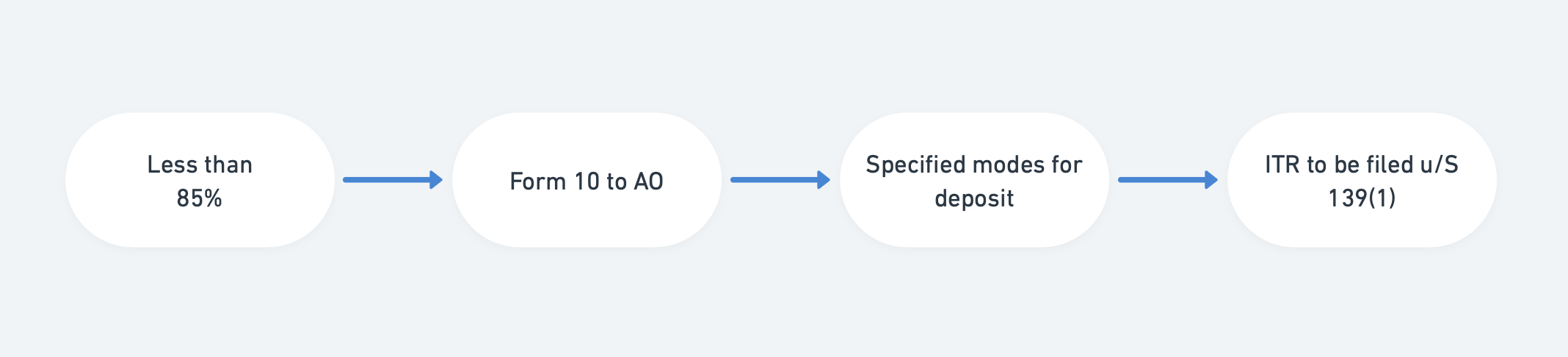
Illustrated: Less than 85% ➡️ Form 10 to AO ➡️ Specified modes for deposit ➡️ ITR to be filed u/S 139(1)
Section 11(4)
Business income of charitable institution
(4) For the purposes of this section "property held under trust" includes a business undertaking so held, and where a claim is made that the income of any such undertaking shall not be included in the total income of the persons in receipt thereof, the Assessing Officer shall have power to determine the income of such undertaking in accordance with the provisions of this Act relating to assessment; and where any income so determined is in excess of the income as shown in the accounts of the undertaking, such excess shall be deemed to be applied to purposes other than charitable or religious purposes.
(4A) Sub-section (1) or sub-section (2) or sub-section (3) or sub-section (3A) shall not apply in relation to any income of a trust or an institution, being profits and gains of business, unless the business is incidental to the attainment of the objectives of the trust or institution, and separate books of account are maintained by such trust or institution in respect of such business.
Section 11(5)
Modes of investment
The forms and modes of investing or depositing the money referred to in clause (b) of sub- section (2) shall be the following, namely:
Investment in savings certificates as defined in clause (c) of section 2 of the Government Savings Certificates Act, 1959 (46 of 1959), and any other securities or certificates issued by the Central Government under the Small Savings Schemes of that Government;
Deposit in any account with the Post Office Savings Bank
Deposit in any account with a scheduled bank or a co-operative society engaged in carrying on the business of banking (including a co-operative land mortgage bank or a co-operative land development bank)
Investment in units of the Unit Trust of India established under the Unit Trust of India Act, 1963 (52 of 1963)
Investment in any security for money created and issued by the Central Government or a State Government
Investment in debentures issued by, or on behalf of, any company or corporation both the principal whereof and the interest whereon are fully and unconditionally guaranteed by the Central Government or by a State Government
Investment or deposit in any public sector company:
Deposits with or investment in any bonds issued by a financial corporation which is engaged in providing long- term finance for industrial development in India and which is eligible for deduction under clause (viii) of sub- section (1) of section 36
Deposits with or investment in any bonds issued by a public company formed and registered in India with the main object of carrying on the business of providing long-term finance for construction or purchase of houses in India for residential purposes and which is eligible for deduction under clause (viii) of sub-section (1) of section 36;
Deposits with or investment in any bonds issued by a public company formed and registered in India with the main object of carrying on the business of providing long-term finance for urban infrastructure in India
Investment in immovable property.
Further additions to 11(5)
Additional as per Rule 17C (March 2018)
Investment in units of any scheme of a mutual fund
Deposit with authority for low cost housing
Stock certificate of Sovereign Gold Bonds
Debt instruments of infrastructure finance company
Acquiring shares of NSDC, Depository
Example of Computation
Case 1
Income derived from property held under trust wholly for charitable purposes
1000
Less: Expenditure (Income applied to charitable purposes in India)
-850
Less: Accumulation under section 11(1)(a) No Specific Form
-150
Taxable Income
NIL
Case 2
Income derived from property held under trust wholly for charitable purposes
1000
Less: Expenditure (Income applied to charitable purposes in India)
-600
Less: Accumulation under section 11(1)(a) No Specific Form
-150
Less: Accumulation under section (11) (2): Form 10, Specific Purpose
-250
Taxable Income
NIL
Case 3
Income derived from property held under trust wholly for charitable purposes (Rs 200 was received in March)
1000
Less: Expenditure (Income applied to charitable purposes in India)
-650
Less: Accumulation under section 11(1)(a) No Specific Form (15% of 1000)
-150
Less: Accumulation as per clause (2) of Explanation to section 11(1), Form 9
-200
Taxable Income
NIL
Disallowance of Cash/bearer Payments
Section 40(A)(3) provides that “Where the assessee incurs any expenditure in respect of which a payment or aggregate of payments made to a person in a day, otherwise than by an account payee cheque drawn on a bank or account payee bank draft or use of electronic clearing system through a bank account [or through such other electronic mode as may be prescribed], exceeds Ten Thousand Rupees, no deduction shall be allowed in respect of such expenditure”.
Note:
Disallowance for Non Deduction of Tax at Source
Section 40(a)(ia) provides that 'Where the assessee fails to deduct the whole or any part of the tax in accordance with the provisions of Chapter XVII-B then the amount equal to 30% of expenditure shall not be allowed at the time of computation of Income’
Note:
Example of Computation
Case 4
Income derived from property held under trust wholly for charitable purposes
1000
Less: Expenditure (Income applied to charitable purposes in India)
-650
Less: Accumulation under section 11(1)(a) No Specific Form (15% of 1000)
-150
Less: Accumulation under section (11) (2): Form 10, Specific Purpose
-200
Add: Expenditure disallowed under section 40 and 40A (30% Expenditure)
30
Taxable Income 30
30
Tax on Income @ 30%
9
Add: Surcharge @ 4%
0.36
Total Tax Liability
9.36
Section 12
Income of trust/ institution from Contribution
Section 12 (1):
Any voluntary contributions received by a trust created wholly for charitable or religious purposes or by an institution established wholly for such purposes (not being contributions made with a specific direction that they shall form part of the corpus of the trust or institution) shall for the purposes of section 11 be deemed to be income derived from property held under trust wholly for charitable or religious purposes and the provisions of that section and section 13 shall apply accordingly.
Section 12 (2):
The value of any services, being medical or educational services, made available by any charitable or religious trust running a hospital or medical institution or an educational institution, to any person referred to in clause (a) or clause (b) or clause (c) or clause (cc) or clause (d) of sub-section (3) of section 13, shall be deemed to be income of such trust or institution derived from property held under trust wholly for charitable or religious purposes during the previous year in which such services are so provided and shall be chargeable to income-tax notwithstanding the provisions of sub-section (1) of section 11
Section 12A
Conditions for Applicability of Section 11 & 12
Section 13
Section 13(1):
Section 11 not to apply when:
Trust for private religious purposes which does not ensure for the benefit of the public.
Trust for charitable purposes or a charitable institution created or established after the commencement of this Act, any income thereof if the trust or institution is created or established for the benefit of any particular religious community or caste.
If such trust or institution has been created or established after the commencement of this Act and under the terms of the trust or the rules governing the institution, any part of such income ensures, directly or indirectly for the benefit of any person referred to in sub-section (3).
If any part of such income or any property of the trust or the institution (whenever created or established) is during the previous year used or applied, directly or indirectly for the benefit of any person referred to in sub-section (3).
Non compliance of Section 11(5)-permitted modes of investment
Section 13(6):
The exemption under section 11 or section 12 shall not be denied in relation to any income, other than the income referred to in sub-section (2) of section 12, by reason only that such trust has provided educational or medical facilities to persons referred to in sub section 3.
Section 13(3)
List of persons:
Section 13(2):
The income or the property of a trust deemed to have been used or applied for the benefit of a person referred to in 13(3)
If any part of the income or property of the trust or institution is, or continues to be, lent to any person referred to in sub-section (3) for any period during the previous year without either adequate security or adequate interest or both.
If any land, building or other property of the trust or institution is, or continues to be, made available for the use of any person referred to in sub-section (3), for any period during the previous year without charging adequate rent or other compensation;
If any amount is paid by way of salary, allowance or otherwise during the previous year to any person referred to in sub-section (3) out of the resources of the trust or institution for services rendered by that person to such trust or institution and the amount so paid is in excess of what may be reasonably paid for such services;
If the services of the trust or institution are made available to any person referred to in sub-section (3) during the previous year without adequate remuneration or other compensation;
If any share, security or other property is purchased by or on behalf of the trust or institution from any person referred to in sub-section (3) during the previous year for consideration which is more than adequate;
If any share, security or other property is sold by or on behalf of the trust or institution to any person referred to in sub-section (3) during the previous year for consideration which is less than adequate
If any income or property of the trust or institution is diverted during the previous year in favour of any person referred to in sub-section (3)
Computation for exemption
Maintaining Books of accounts for NGOs
Books of accounts & other documents:
Implication of Non-Maintenance of Books of Account:
Section 13(10) and (11) inserted wef AY 22-23 stating that Income chargeable to tax shall be computed after allowing a deduction forexpenditure incurred for the objects of the institution subject to fulfilment of the following conditions, namely:
Income Tax Bill 2025
Provision for Charitable institutions
The Bill introduces the term “Registered Nonprofit Organization” (Registered NPO) as a unified definition for all charitable entities i.e. society, Trust, S8, Univ etc.
Consolidation of Provisions for NPOs into a Single Chapter: Chapter 17B-Special Provisions for Registered NPOs-(Clause 332-355). This chapter is divided into seven structured subparts:
Changes in Taxability and Compliance Requirements: Under the current tax law, provisions related to the taxability of NPOs’ income are spread across multiple sections, such as:
Simplified Application of Income Provisions: The Existing Section 11 provisions regarding the application of income are complex due to multiple explanations and cross-references. The new bill consolidates all application-related provisions in one section, making it easier to determine:
Elimination of Deemed Application Concept: The new bill removes the deemed application concept for shortfall in 85% application out of income.
Enhanced Accumulation Provisions: Bill eliminates restrictions on the purpose of accumulation for five-year accumulation . Nonprofits can now accumulate funds for any objective within their registered mandate.
Please note: Information is for reference only. Read our disclaimer here.