Labour Codes 2025 (Pacta)
- An overview of the four Labour Codes
- Code on Wages, 2019
- Code on Social Security, 2020
- Industrial Relations Code, 2020
- Occupational Safety, Health and Working Conditions Code, 2020
An overview of the four Labour Codes
This resource was originally created by Pacta. We’re thankful for the time and care they’ve put into making this information accessible.
You can read the information below in over 15 languages! Simply use the translation tool in the top-left corner of the screen to select your preferred language, including অসমীয়া, বাংলা, ગુજરાતી, हिन्दी, ಕನ್ನಡ, മലയാളം, मराठी, মৈতৈলোন্, नेपाली, ଓଡ଼ିଆ, ਪੰਜਾਬੀ, संस्कृतम्, தமிழ், తెలుగు, and اُردُو.
Background
The Labour Codes aim to create a unified and streamlined labour framework by consolidating 29 Central labour laws into four comprehensive codes. Notified on 21 November 2025, they introduce a structured approach to wage regulation, social security, industrial relations, and workplace safety. By doing so, the Codes seek to reduce compliance complexity, clarify obligations for employers, expand worker coverage, and bring greater consistency across labour practices, without positioning any single interest above another.
They comprise:
-
The Code on Wages, 2019 standardises wage definitions and governs minimum wages, floor wages, and payment of wages and bonuses.
-
The Industrial Relations Code, 2020 regulates trade unions, standing orders, industrial disputes, and mechanisms for ensuring industrial peace.
-
The Code on Social Security, 2020 integrates nine social security laws to extend EPF, ESI, gratuity, maternity benefits, and welfare schemes to organised, unorganised, gig, and platform workers.
-
The Occupational Safety, Health and Working Conditions (OSH) Code, 2020 consolidates 13 laws relating to workplace safety, health, welfare standards, working conditions, and protections for migrant and contract workers.
Overview of the four labour codes
1. Code on Wages, 2019
-
Payment of Wages Act, 1936
-
Minimum Wages Act, 1948
-
Payment of Bonus Act, 1965
-
Equal Remuneration Act, 1976
2. Industrial Relations Code, 2020
-
Industrial Disputes Act, 1947
-
Trade Unions Act, 1926
-
Industrial Employment (Standing Orders) Act, 1946
-
Employees' Provident Funds & Miscellaneous Provisions Act, 1952
-
Employees' State Insurance Act, 1948
-
Employees' Compensation Act, 1923
-
Maternity Benefit Act, 1961
-
Payment of Gratuity Act, 1972
-
Cine Workers Welfare Fund Act, 1981
-
Building and Other Construction Workers Welfare Cess Act, 1996
-
Unorganised Workers' Social Security Act, 2008
-
Employment Exchanges (Compulsory Notification of Vacancies) Act, 1959
4. Occupational Safety, Health and Working Conditions (OSH) Code, 2020
-
Factories Act, 1948
-
Mines Act, 1952
-
Dock Workers (Safety, Health and Welfare) Act, 1986
-
Building and Other Construction Workers (Regulation of Employment and Conditions of Service) Act, 1996
-
Plantations Labour Act, 1951
-
Contract Labour (Regulation and Abolition) Act, 1970
-
Inter-State Migrant Workmen (Regulation of Employment and Conditions of Service) Act, 1979
-
Working Journalists and Other Newspaper Employees (Conditions of Service and Miscellaneous Provisions) Act, 1955
-
Working Journalists (Fixation of Rates of Wages) Act, 1958
-
Motor Transport Workers Act, 1961
-
Sales Promotion Employees (Conditions of Service) Act, 1976
-
Beedi and Cigar Workers (Conditions of Employment) Act, 1966
-
Cine Workers and Cinema Theatre Workers (Regulation of Employment) Act, 1981
Compliance checklist
This table outlines all organisational obligations arising after the enactment of the four Labour Codes, including several legal requirements that already existed under the previous statutes. Please also refer to the colour codes used to indicate the specific Acts.
- → Code on Wages, 2019
- → Industrial Relations Code, 2020
- → Code on Social Security, 2020
- → Occupational Safety, Health and Working Conditions (OSHWC) Code, 2020
| Key Themes | Compliance Requirements |
|
Workers/Employees |
|
| Wage Entitlements |
i. Receive at least minimum wages applicable to skill & region. ii. Confirm wages are national floor wage. iii. Check wage slip received monthly. iv. Ensure overtime rate which shall not be less than twice the normal rate of wages. v. Fixed-term employees receive parity in wages & benefits, and gratuity after 1 year. vi. Right to Equal Remuneration (no gender-based discrimination in wages & recruitment). vii. Right to Claim Unpaid Wages / Wrongful Deductions / Bonus. viii. Eligible for bonus 8.33%-20% if below wage ceiling. |
| Social Security Eligibility |
i. Covered under EPF if establishment $\ge$ 20 employees (or voluntary). ii. Covered under ESIC if applicable, check if hazardous occupation. iii. Gig/platform workers registered on National Database. iv. Migrant workers registered for benefit portability. |
Leave & Benefits |
i. Eligible for bonus 8.33%-20% if below wage ceiling |
|
ii. Maternity benefits (women workers): a) 26 weeks paid leave. b) Nursing breaks. c) ₹3,500 medical bonus (if facilities not provided). d) Work-from-home option after childbirth (if agreed). |
|
| Workplace Safety & Welfare |
i. Access to safe workplace & protective equipment. ii. Annual health check-up provided. iii. Crèche facility if establishment has $\ge$ 50 workers. iv. Safety committee present (if thresholds met). v. Right to report accidents including commuting accidents. vi. Women are allowed to work between 6 AM to 7 PM subject to conditions. The Government may also prohibit women from working in certain establishments that could pose danger to their safety and health. |
| Rights & Industrial Relations |
i. 14 days' notice before participating in a strike. ii. Protected from discrimination based on gender/trans identity. iii. Representation in Grievance Redressal Committees (women proportionate to workforce). |
|
Employers |
|
| Wage & Payroll Compliance (Employers) |
i. Ensure "Wages" = minimum 50% of total CTC (cap on exclusions). ii. Pay wages within statutory timelines: a) Daily: end of shift; b) Weekly: before weekly holiday; c) Fortnightly: within 2 days; d) Monthly: within 7 days; e) Termination dues: within 2 days. iii. Issue wage slips every month. iv. Ensure payment to piece-rate workers meets minimum time rate. |
| Organisational Compliance (Employers) |
i. Prepare Standing Orders if workforce $\ge$ 300. ii. Union recognition: if 51% membership $\rightarrow$ negotiate with that union. iii. Maintain digital registers, single annual return, e-records. iv. Use Inspector-cum-Facilitator mechanism for cooperative compliance. v. File for single registration & 5-year unified licence. vi. Maintain registers of wages, deductions, fines, overtime, and bonus, in formats prescribed by rules. vii. Provide wage slips and records electronically, where applicable. viii. Display or provide notices wherever required (e.g., wage rates, working hours, payment dates). |
| Social Security (Employers) |
i. Register employees under EPFO & ESIC as applicable. Register any person before taking him into employment. Registration shall be completed on an online portal (to be specified) through Aadhaar. ii. Ensure ESIC for hazardous occupations regardless of establishment size. iii. Ensure EPF inquiries completed within 2 years (limitation). iv. Provide contribution details transparently to workers. v. Fails to provide insurance to its employee, he shall be liable to pay the exact amount of benefit to the employee is as if the negligence or failure did not occur. vi. Maintain records and register the details, electronically or otherwise, the number of employees, wages, number of days and hours worked, number of leaves, deductions, any accidents or bodily injuries, cess paid, vacancies and other details. |
| Health, Safety & Welfare (Employers) |
i. Conduct risk assessments, exposure monitoring & medical exams. ii. Provide free annual health check-ups. iii. Set up crèche if 50 workers. iv. Establish Safety Committee if thresholds met: a) Factories 500; b) BOCW 250; c) Mines 100. v. Provide protective equipment, safety protocols, emergency drills. vi. Provide uniform and adequate measures by employers for the welfare of employees. It includes hygienic work environment with ventilation, temperature and humidity, sufficient space, drinking water. vii. Ensure suitable and hygienic facilities for washrooms, medical examinations, creches, first-aid boxes, sitting arrangements, canteens, locker rooms etc. viii. Ensure there is an ambulance room in every factory, mine and construction site employing 500 workers or more; and welfare officer in every factory, mine or plantation employing 250 workers or more. |
| Contractor & Migrant Worker Management |
i. Ensure contract labour threshold compliance (now 50). ii. Provide welfare facilities & ensure unpaid wages of contractors are settled. iii. Register & support migrant workers for benefit portability. iv. Ensure journey allowance for inter-state migrant workers. v. Verify that contractors follow minimum wage, payment deadlines, permitted deductions, and bonus rules. vi. Employers can later recover amounts from the contractor but cannot delay payments to workers. |
Gender & Inclusion |
i. No gender or transgender discrimination in employment or wages. |
|
ii. Women allowed night work with safeguards (transport, security). iii. Ensure women representation in advisory & grievance committees. iv. Equal opportunity in hiring, wage rates, and bonus entitlement for men, women, and transgender persons if applicable under rules. |
|
|
v. Provide maternity benefits (26 weeks). |
|
| Disputes & Offences |
i. Respond to improvement notices within 30 days. ii. Compounding procedures (50%-75% of fine) for minor offence. s. iii. Maintain documentation for time-bound dispute mechanisms. iv. Ensure compensation payment from 50% of fines where applicable. |
|
Contractors |
|
| Registration & Licensing |
Registration & Licensing i. Register under the OSHWC Code if employing 50 contract workers. ii. Obtain required contractor licence (now digitised & centralised). iii. Maintain single annual return digitally. |
| Wage & Social Security Compliance |
i. Pay wages at minimum wage or above. ii. Ensure wages comply with the 50% wage structure rule. iii. Provide wage slip or passbook to contract workers. iv. Ensure timely wage payment; employer is liable if contractor defaults. |
|
v. Deposit EPF/ESIC contributions for eligible contract labour. |
|
| Work Conditions & Safety |
i. Provide PPE, safety training & adherence to employer's safety rules. ii. Ensure contract workers are included in workplace safety committees where applicable. iii. Report accidents immediately (including commuting accidents). |
| Inter-State Migrant Workers |
i. Register all migrant workers on portals. ii. Provide journey allowance & ensure portability of benefits. iii. Provide boarding, lodging & helpline awareness. |
|
Worker Rights & Inclusion |
i. No discrimination based on gender or transgender identity. ii. Provide equal wages for equal work. iii. Ensure maternity, overtime & leave benefits are honoured if applicable. |
|
Documentation & Transparency |
i. Maintain records of deployment, attendance, wages, EPF/ESIC. |
|
ii. Share documentation with principal employer for audits. Comply with inspections via inspector-cum-facilitator. |
|
Implementation roadmap of the four labour codes
The table below reflects the new obligations introduced by the Labour Codes however, many of them will come into force only through rules and notifications issued by the Central Government and the respective State Governments. We will continue sharing updates. In the meantime, it is important for organisations to familiarise themselves with the new legal framework so they are prepared, aware, and compliant once the provisions take effect. Please note that the Industrial Relations Code, 2020 does not apply to institutions owned or managed by organisations wholly or substantially engaged in charitable, social, or philanthropic services.
Code on Wages, 2019
| Area | Compliance Requirements |
| Applicability and Regulation | The Code applies to all establishments, employers and employees. Regulates wage and bonus payments in all employments where any industry, trade, business, or manufacture is carried out. |
| Wage Definition | Definition of "wages" include basic pay, dearness allowance and retaining allowance. It does not include bonus, travelling allowance, housing allowance or contributions made to provident fund/pension, gratuity etc.,. |
| Floor Wage | The central government will fix a floor wage, taking into account living standards of workers. Further, it may set different floor wages for different geographical areas. Before fixing the floor wage, the central government may obtain the advice of the Central Advisory Board and may consult with state governments. The minimum wages decided by the central or state governments must be higher than the floor wage. In case the existing minimum wages fixed by the central or state governments are higher than the floor wage, they cannot reduce the minimum wages. |
| Payment of Wage | No employee shall pay less than minimum wages fixed in accordance with Section 9. normal working day shall comprise of eight hours of work with one or more intervals for rest which shall not exceed one hour (in total). In case employees work in excess of a normal working day, they will be entitled to overtime wage, which must be at least twice the normal rate of wages. |
| Wage Period | Wage period for employees shall be either as daily or weekly or fortnightly or monthly subject. |
| Appointment of Committees | Appropriate Committees shall be appointed for revision of Minimum Wages. Revision of pay every 5 years. |
| Registers | Register containing the details of the employees, muster rolls and wages shall be maintained. |
| Penalties |
The Code specifies penalties for offences committed by an employer, such as (i) paying less than the due wages, or (ii) for contravening any provision of the Code. Penalties vary depending on the nature of offence, with the maximum penalty being imprisonment for 3 months along with a fine of up to INR 1,00,000. |
| Inspections | Engage with Inspector-cum-Facilitators for advisory inspections. |
Industrial Relations Code, 2020
| Area | Compliance Requirements |
| Applicability | Applicable to all industrial establishments. Not applicable to establishments which are set up to carry out charitable activities. |
| Works Committee | Works Committee shall be constituted in an Industrial Establishment where more than one hundred workers work. |
| Grievance Redressal Committee | Grievance Redressal Committee shall be constituted in an Industrial Establishment where more than twenty workers work. Ensure women's representation in grievance committees. |
| Formation and Registration of Trade Union | A Trade Union shall be formed and shall be registered by seven or more members of the Trade Union. |
| Industrial Tribunal | The industrial tribunal will consist of two members out of whom one shall be a judicial member, and the other will be an administrative member. |
| Standing Orders | Model Standing Orders for establishments with 300+ workers. Adopt/update. |
| Reskilling Fund | Deposit 15 days' wages per retrenched worker; maintain documentation. |
| Penalties | Penalties are upto INR 2,00,000. In case of non-certification of standing orders, an additional fine of INR 2,000 per day during which the contravention continues. |
| Strikes/Lockouts | Systematise notice periods, track conciliation timelines. |
Code on Social Security, 2020
| Area | Compliance Requirements |
| Applicability |
The Code incorporates a number of social security measures for employees and lays down different thresholds. • For Employees' Provident Fund: Applicable on establishments that employ 20 or more employees. • For Employees' State Insurance: Applicable on establishments (other than a seasonal factory) that employ 10 or more employees. Threshold shall not be applicable if the establishment carries on hazardous or life-threatening occupation. • For Gratuity: Applicable on shops or establishments that employ 10 or more employees. There is no such threshold for factories, mines, oilfield, plantation or railway company. • For Maternity Benefit: Applicable on shops or establishments that employ 10 or more employees. Also applicable on factory, mine, plantation and establishment belonging to government. • For Employees' Compensation: Applicable to employees as mentioned in Second Schedule of the Code. |
| Registrations |
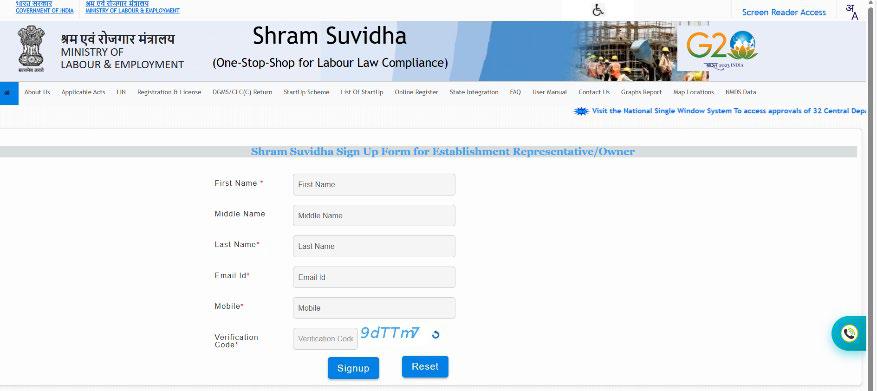
• Register under EPFO/ESIC; maintain digital records. All establishments that are covered under the Act shall apply for registration via Shram Suvidha Portal. If the establishment is already registered under any Central labour law, it shall update the information on the portal. • Registration for Insurance of Employees: An employer, to which obligations under Employees' State Insurance applies, shall register any person before taking him into employment. Registration shall be completed on an online portal (to be specified) through Aadhaar. • Registration of building workers: A building worker, between the age of 18-60 years, who has engaged in any building or other construction work for at least 90 days shall be registered as a beneficiary by the State government or State Building Workers' Welfare Board. • Registration of Unorganised, Gig and Platform Workers: An unorganised/gig/platform worker, who has completed the age of 16 years, shall apply for registration. |
| Aggregator Contributions | Compute and remit 1-2% of turnover (capped at 5% of payouts). |
| Fixed-Term Employees | Provide gratuity after 1 year of continuous service. |
| Maternity & Welfare | Provide maternity benefits, crèches, flexible work where required. |
| Digital Integration | Aadhaar/UAN linking; onboard unorganised workers on e-Shram. |
| Penalties | The Code specifies penalties for offences committed by an employer, such as (i) paying less than the due wages, or (ii) for contravening any provision of the Code. Penalties vary depending on the nature of offence, with the maximum penalty being imprisonment for 3 months along with a fine of up to INR 1,00,000. |
| Inspections | Cooperate with technology-based inspections. |
Occupational Safety, Health and Working Conditions Code, 2020
| Area | Compliance Requirement |
| Applicability | Applicable to all establishments employing 10 or more workers. It will also be applicable to mines and docks even if they employ just one worker. The Code shall not apply to the offices of the Central government, offices of the State government and any ship of war of any nationality. However, within the exception, the Code shall apply in case of contract labour employed through a contractor wherein the Central/State government is the principal employer. |
| Applicability of Part on Contract Labour | Applicable on establishments or manpower supply contractors in which 50 or more contract labour are employed. Not applicable on establishments where work of intermittent or casual nature is performed. |
| Applicability of Part on Inter-State Migrant Workers | Applicable on establishments in which ten or more inter-State migrant workers are employed. |
| Applicability of Part on Mines | The Code is generally applicable on mines. However, the Code is not applicable on: Any mine in which excavation is being made for prospecting purposes only; Any mine engaged in the extraction of kankar, murrum, laterite, boulder, gravel, shingle, ordinary sand, ordinary clay, building stone, slate, road metal, earth, fullers earth and limestone. |
| Applicability of Part on Beedi and Cigar Workers | This Part shall not be applicable to owner or occupier of a private dwelling house where manufacturing process is being carried out with the assistance of the family members. |
| Registration | Employers of all establishments, employing 10 or more employees or any other notified establishment must register within 6 months. Application for registration has to be made in Form II at Shram Suvidha Portal. Documents related to Registration of the establishment; proof of Identity and address of the employer(s) are required for registration. If the establishment is already registered under any central labour law shall update the information on the portal. |
| Registration of Inter-State Migrants | Inter-state migrants have to be registered on an online portal (to be specified) on the basis of self-declaration and Aadhaar. |
| Appointment Letters | Mandatory Letter of Appointment for all workers. |
| Levy of Charge | No Charge should be levied on any employee with regards to maintenance of safety and health of workers. |
| Right to obtain Information | Employee has the Right to obtain information regarding Employee's health and safety at work. |
| Formation of Board | National and State Occupational Safety and Health Advisory Board are constituted to frame Rules and Regulations and implement the provisions of the Code. |
| Work Hours | 8 Hours a day, twice the wages in case of overtime with consent. Overtime wages are payable at twice the ordinary rate of wages. The period of overtime shall be calculated on a daily or weekly basis, whichever is more favourable to the worker. |
| Welfare Facilities | Bathing places, Locker Rooms, Place of keeping clothing, Sitting Arrangement, Canteen, First Aid Boxes, Medical Examinations. |
| Employment of Women | Women shall be employed in all kinds of work and shall be employed before 6 am and beyond 7 pm, only with consent. |
| Contract Labour | Register contractors; ensure welfare; make wage payments if contractor defaults. |
| Safety Systems | Allow third-party audits; implement safety committees for large establishments. |
| Penalties | For contraventions of Code, rules, regulations or by-laws, the employer is liable for a penalty of Rs. 2-3 lakhs. A number of other penalties are prescribed for specific offences. |
Code on Wages, 2019
This resource was originally created by Pacta. We’re thankful for the time and care they’ve put into making this information accessible.
You can read the information below in over 15 languages! Simply use the translation tool in the top-left corner of the screen to select your preferred language, including অসমীয়া, বাংলা, ગુજરાતી, हिन्दी, ಕನ್ನಡ, മലയാളം, मराठी, মৈতৈলোন্, नेपाली, ଓଡ଼ିଆ, ਪੰਜਾਬੀ, संस्कृतम्, தமிழ், తెలుగు, and اُردُو.
Background
The Code on Wages, 2019 is a landmark labour law reform aimed at simplifying and strengthening India’s wage regulation framework. Effective from 21 November 2025, it applies uniformly across sectors and categories of employment, marking a decisive shift towards universal wage regulation. Prior to the enactment of the Code, wage-related matters were governed by multiple central laws, each operating with different definitions, thresholds, and enforcement mechanisms. This fragmented framework often led to ambiguity, uneven application, and exclusion of workers, particularly in the unorganised sector. Drawing from the recommendations of the Second National Commission on Labour and subsequent policy deliberations, the Code on Wages, 2019 was enacted to consolidate and rationalise wage laws, ensure consistency in wage standards, and balance worker welfare with ease of doing business.
Subsumed Laws
-
Payment of Wages Act, 1936
-
Minimum Wages Act, 1948
-
Payment of Bonus Act, 1965
-
Equal Remuneration Act, 1976
Applicability
-
Applies to all establishments, irrespective of size, sector, or nature of operations
-
Covers both organised and unorganised sectors
-
Applicable to:
i. Permanent employees
ii. Fixed-term and contractual workers
iii. Daily wage and piece-rate workers
iv. Other categories of workers recognised under the Code
Key Structural Reforms
-
Introduction of a uniform statutory definition of “wages”
-
Extension of minimum wages to all employments
-
Provision for fixation of a national floor wage
-
Strengthened prohibition on gender-based discrimination in recruitment and wage payment
-
Establishment of a unified, facilitative inspection and compliance mechanism
-
Enhanced focus on transparency, consistency, and ease of compliance
Comparison of Key Legal Provisions between Old Regimes and New Code on Wages, 2019
Table 1: Comparison Of Key Legal Provisions Between Old Laws (Pertaining to Wages) And New Code on Wages, 2019
| Old Regime (Previous Acts) | New Regime (Code on Wages, 2019) | Impact |
|---|---|---|
| Coverage: Restricted to “Scheduled Employments” (approx. 30% of workforce) and specific wage ceilings. | Applies to all employees in all establishments (organised & unorganised), irrespective of wage ceilings or sector. | Expands the compliance universe to cover all categories of workers, including contractual and project-based personnel, reducing ambiguity on applicability. |
| Definition of Wages: Varied across the four different Acts. Led to confusion and litigation regarding what constitutes “basic wage” for PF/Gratuity. | Standardised across all provisions. “Wages” refers to all remuneration payable to an employee for employment or work done, whether described as salary, allowance, or otherwise, and whether paid in money or capable of being expressed in money, provided the employee has fulfilled the terms of employment. | Introduces the “50% Rule” that allowances cannot exceed 50% of total remuneration. (See Box 1). Requires review and possible restructuring of remuneration components to align with the statutory wage definition, with implications for statutory contributions. |
| Minimum Wage: Fixed by States for “Scheduled Employments” only. Rates varied wildly between states for similar work. | The Central Government fixes a “Floor Wage.” State fixed minimum wages cannot be lower than this Floor Wage. | Introduces a uniform minimum wage, improving wage predictability, while potentially increasing payroll costs in lower-wage states. |
| Bonus Eligibility: Applicable at 8.33% - 20% of the salary or wage earned during that year. Payable only to employees earning up to ₹21,000/month and worked at least 30 days in that year. Exempts not for profit organisations from payment of bonus. | Applicable at 8.33% - 20% of annual wage/ salary. Payable to employees who have worked at least 30 days in that year (Wage ceiling for eligibility is to be notified by the appropriate Government.) Exempts not for profit organisations from payment of bonus. | Retention of exemption avoids additional financial burden while maintaining statutory clarity on eligibility thresholds. |
| Gender Discrimination: Limited to “Equal Pay for Equal Work” for men and women. | Prohibits discrimination in recruitment and conditions of employment, not just pay. Includes transgender individuals. | Employers must audit hiring practices, role classification, and pay parity frameworks. |
| Weekly Day of Rest: Required provision of one day of rest in every seven days, with payment of remuneration, subject to applicable rules. | Retains the same requirement to provide one paid day of rest in every period of seven days to employees or specified classes. | Requires uniform scheduling of weekly rest days and ensuring paid rest, impacting workforce planning and wage budgeting. |
| Timeline for Full & Final Settlement: Dismissal/Removal: Within 2 working days. Resignation: No specific timeline (usually paid in the next wage cycle). | Wages must be paid within 2 working days for all separations, such as resignation, dismissal, retrenchment, or closure (See Table 3). | Requires employers to streamline and expedite their exit payroll and settlement process. |
| Inspection: “Labour Inspectors” with a focus on policing and penalties. Physical inspections were common. | “Inspector-cum-Facilitators” Focus on enabling compliance. Inspections can be web-based, randomised, and transparent. | Reduces adversarial enforcement and promotes compliance through guidance and technology-driven oversight. |
| Penalties: Complex mix of fines and imprisonment; often outdated low monetary fines. | Decriminalised for many first-time offenses. Fines are significantly higher, up to ₹50,000 or ₹1 Lakh. Imprisonment is generally reserved for repeat offenders. Compounding of offence is allowed even after the process of prosecution has been initiated. | Shifts the compliance approach from punitive to corrective, encouraging timely rectification while strengthening deterrence for persistent non-compliance. |
Implication of Code on Wages, 2019 for Non-profit Organisations
A. On amount of wages payable:
-
Under the old regime, minimum wages only applied to specific “scheduled employments.” This left large sections of workers uncovered. The new Wages Code extends the right to minimum wages to all employees across all establishments, regardless of the sector or the wage ceiling. The minimum wages are expected to be notified by the state governments from time to time and shall be the wages payable for various types of roles.
-
The States had varied minimum wages under the old regime. Now, the Central Government will fix a “National Floor Wage” based on minimum living standards. State governments cannot fix minimum wages lower than this floor wage. However, this is yet to be notified. Until it is so notified, the existing minimum wages notifications shall apply.
-
The Wages Code also introduces a unified definition of wages. Earlier, various allowances, such as HRA or conveyance, often constituted the bulk of the salary, keeping the basic wage low to reduce Provident Fund (PF) or gratuity liabilities. Under the Wages Code, if “other benefits” exceed 50% of the total remuneration, the excess amount will be added back to the “wages” for calculating social security contributions. The new Code prevents employers from structuring salaries with low basic pay and is likely to have the impact of increasing contributions to PF and gratuity (See Box 1).
-
First non-compliance with provisions on wages would attract fine of INR 50000/-. Hence non-profits must revisit their salary structures and ensure compliance.
Computation of Wages Compliant with Code on Wages
Typical Components Included in Wages
The following elements usually form part of wages:
-
Basic Pay
-
Dearness Allowance (DA)
-
Retaining Allowance, if applicable
Typical Components Excluded from Wages
The following payments are generally excluded from the computation of wages:
a. Statutory or non-contractual bonus not forming part of employment terms
b. Value of house accommodation or amenities such as light, water, medical facilities, or services excluded by government order
c. Employer’s contribution to provident fund or pension, including accrued interest
d. Conveyance allowance or travel concessions
e. Reimbursement of special employment-related expenses
f. House Rent Allowance (HRA)
g. Payments under awards, settlements, or court/tribunal orders
h. Overtime allowance
i. Commission
j. Gratuity payable on termination
k. Retrenchment compensation, retirement benefits, or ex gratia payments on termination
Ceiling on Exclusions (50% Rule)
If the total of payments made under the excluded categories (a to i) exceeds 50% of the total remuneration (or any other percentage notified by the Central Government):
-
The excess amount beyond such limit shall be treated as wages, and
-
This excess will be added back to the wage calculation.
Remuneration in Kind
Where an employee receives remuneration in kind (instead of money, wholly or partly), The value of such remuneration up to 15% of total wages shall be deemed to form part of wages.
Illustration: NPO X employs Ravi as a senior programme manager. His monthly remuneration is:
Basic Pay: ₹25,000
Dearness Allowance (DA): ₹5,000
House Rent Allowance (HRA): ₹30,000 (excluded from wages)
Conveyance Allowance: ₹10,000 (excluded from wages)
Performance Incentive: ₹15,000 (excluded from wages)
Step 1: Total Remuneration
25,000 + 5,000 + 30,000 + 10,000 + 15,000 = ₹85,000Step 2: Total of Excluded Payments
HRA + Conveyance + Incentive = 30,000 + 10,000 + 15,000 = ₹55,000Step 3: Threshold (50% of total remuneration)
50% of 85,000 = ₹42,500Step 4: Excess over threshold
Excluded payments = 55,000 → Threshold = 42,500 → Excess = 55,000 – 42,500 = ₹12,500Step 5: Wages for statutory purposes
Basic + DA + excess excluded payments = 25,000 + 5,000 + 12,500 = ₹42,500Even though Ravi’s total pay is ₹85,000, for statutory purposes like minimum wages, PF, or gratuity calculation, his wages are considered ₹42,500, because the excess of excluded payments over 50% of total remuneration is added back.
B. On bonus and overtime
-
All employees in respect of whom minimum wages are notified are entitled to receive overtime wages at a rate of at least twice the rate of normal wages if they work beyond normal hours. Previously, overtime wage rates varied depending on specific state discretion.
-
It also enforces a strict cap on deductions (PF, ESI, income tax, court orders, cooperative society dues) on pay at 50% of the employee’s total wages in all cases. Earlier, under the Payment of Wages Act, 1936, deductions could go up to 75% for payments to cooperative societies, and 50% in other cases.
C. On record keeping by employer
Table 2 - Statutory Wage & Payroll Registers – Compliance Overview
| Category / Parameter | Requirement / Rule | Illustrative Example / Notes |
|---|---|---|
| Wage Register | Mandatory for all establishments | From date of last entry |
| Wage slips | To be issued to every employee | Digital or physical |
| Fine Register | Required if fines are imposed | Mandatory where applicable |
| Deduction Register | Records all wage deductions | Covers all authorised deductions |
| Overtime Register | Required where overtime applies | Applicable establishments only |
D. On time for wage payment and mode of wage payment
-
The Code mandates that wages be paid timely, by the 7th of the next month, and that a full and final settlement be done within two days of an employee’s resignation or removal.
-
The new Code also recognises the payment of wages through electronic modes, in addition to the traditional coins, currency notes, cheques, and bank credits.
Table 3: Timelines for Payment of Wages Based on Mode of Engagement and Separation
| Basis of Engagement / Situation | Statutory Time Limit for Payment of Wages | Illustrative / Clarificatory Note |
|---|---|---|
| Daily basis employees | At the end of the shift | Wages payable immediately after completion of the shift |
| Weekly basis employees | On the last working day of the week (before the weekly holiday) | Payment to be made prior to the weekly off |
| Fortnightly basis employees | Before the expiry of the second day after the end of the fortnight | Two-day outer limit after the fortnight ends |
| Monthly basis employees | Before the expiry of the seventh day of the succeeding month | Example: October wages payable by 7 November |
| Removal or dismissal from service | Within two working days of removal or dismissal | Final wage settlement within two working days |
| Retrenchment, resignation, or closure of establishment | Within two working days of retrenchment, resignation, or closure | Applies regardless of reason for separation |
Table 4: Permitted Modes of Wage Payment and Compliance Requirement
| Permitted Mode of Wage Payment | Status | Timeline / Condition | Compliance Note |
|---|---|---|---|
| Electronic Transfer (preferred) | Permitted | Ongoing compliance | Direct credit to employee’s bank account with wage slip; digital wage slip encouraged |
| Cash Payment | Permitted with safeguards | During working hours | Payment at workplace with proper documentation |
| Cheque / Demand Draft | Permitted with employee consent | As agreed | Proper records mandatory |
E. On offences and penalties
-
Compounding of offences is a legal mechanism that allows an employer to settle certain non-serious statutory violations by paying the prescribed fine instead of facing prosecution. It is generally permitted only for offences not punishable with imprisonment and is intended to reduce litigation while ensuring regulatory compliance. Earlier, compounding offences was only allowed in certain states. The new Code provides for the compounding of offences which are not punishable by imprisonment, and this is applicable everywhere.
Compounding is only allowed for a sum of 50% of the maximum fine provided for the relevant offence. However, this option is not available to employers who commit an offence for the second time or within a period of five years from either (i) commission of a similar offence which was earlier compounded; or (ii) commission of a similar offence for which such person was earlier convicted.
What lies ahead?
Although the Code on Wages, 2019 has been enacted, its practical operation depends on detailed Central and State notifications. Several critical aspects of day-to-day compliance are yet to be fully notified.
-
Fixation of National Floor Wage by the Government
-
Prescription of daily and weekly working hour limits, beyond which overtime wages will become payable
-
Working hours for certain classes of employees, including those engaged in unforeseen emergency work outside normal working hours as under Section 13(2) of the Code
-
Weekly day of rest and conditions for payment where employees work on rest days
-
Conditions governing intermittent work, emergency work, and employment in specific sectors
-
Determination of normal working day hours, entitlement to a day of rest, and conditions for payment where employees are required to work on rest days
-
Stipulation of the period for preservation and retention of wage and employment records
Pacta will continue to track developments and update this section as and when the Central and State Governments notify the relevant Rules.
Code on Social Security, 2020
This resource was originally created by Pacta. We’re thankful for the time and care they’ve put into making this information accessible.
You can read the information below in over 15 languages! Simply use the translation tool in the top-left corner of the screen to select your preferred language, including অসমীয়া, বাংলা, ગુજરાતી, हिन्दी, ಕನ್ನಡ, മലയാളം, मराठी, মৈতৈলোন্, नेपाली, ଓଡ଼ିଆ, ਪੰਜਾਬੀ, संस्कृतम्, தமிழ், తెలుగు, and اُردُو.
Background
Laws Subsumed under the SS Code
- Employees' Compensation Act, 1923
- Employees' State Insurance Act, 1948
- Employees' Provident Funds and Miscellaneous Provisions Act, 1952
- Employment Exchanges (Compulsory Notification of Vacancies) Act, 1959
- Maternity Benefit Act, 1961
- Payment of Gratuity Act, 1972
- Cine-Workers Welfare Fund Act, 1981
- Building and Other Construction Workers Welfare Cess Act, 1996
- Unorganised Workers' Social Security Act, 2008
Objectives of the SS Code
- Consolidation of Existing Laws: To streamline multiple central labour laws relating to social security into a single comprehensive framework.
- Universalisation of Social Security: To extend social security coverage to all employees and workers, irrespective of whether they belong to the organised or unorganised sector.
- Inclusion of Diverse Categories of Workers: To bring within its ambit self-employed workers, home workers, wage workers, migrant workers, unorganised sector workers, gig workers and platform workers.
- Provision of Comprehensive Benefits: To provide access to schemes relating to life and disability insurance, health and maternity benefits, provident fund, gratuity and other welfare measures.
- Recognition of New Forms of Employment: To acknowledge evolving work arrangements and ensure protection even in non-traditional employment relationships.
- Simplification and Rationalisation of Compliance: To create a uniform and technology-driven framework for registration, contribution and administration of social security schemes.
Comparison of Key Legal Provisions between Old Regimes and Code on Social Security 2020
| Feature | Old Labour Laws | Code on Social Security, 2020 | Impact |
|---|---|---|---|
| Social Security Benefits Accessibility | Earlier, social security benefits were governed by multiple sector-specific statutes such as the EPF Act, 1952, ESI Act, 1948, Payment of Gratuity Act, 1972 and Unorganised Workers' Social Security Act, 2008, with applicability dependent on workforce thresholds, wage ceilings and existence of a traditional employer-employee relationship. | The Code on Social Security, 2020 adopts an expanded and inclusive approach by extending coverage to employees, unorganised workers, gig workers, platform workers and fixed-term employees | Universalisation of social security coverage across workforce |
| Unified Definitions | Under the earlier labour law regime, key terms such as wages, employee, employer and establishment were defined differently across statutes like the EPF Act, ESI Act and Payment of Wages Act, resulting in interpretational inconsistencies | The Code on Social Security, 2020 introduces standardised definitions under Section 2, particularly Section 2(88) for wages, thereby reducing ambiguity and facilitating uniform enforcement. | Reduces litigation and interpretational confusion |
| Definition of Wages | Different definitions across statutes (EPF Act, ESI Act, Payment of Wages Act etc.). Generally included basic wages and certain allowances while excluding HRA, bonus, overtime, commission and several other allowances -- but scope varied under each law leading to litigation. | Uniform definition under Section 2(88). Wages include all remuneration expressed in monetary terms payable to an employee if terms of employment are fulfilled, including basic pay, dearness allowance and retaining allowance. Excludes bonus, HRA, overtime, commission, conveyance allowance and other prescribed exclusions subject to the 50% cap rule (if exclusions exceed 50% of total remuneration, the excess is added back to wages) | Higher contribution base & clarity |
| Unified Social Security Organisations | EPFO, ESIC, Welfare Boards operated independently | Integrated framework with expanded role of National & State Social Security Boards | Better coordination and accountability |
| Digitalisation of Infrastructure | Paper-based compliance; separate forms, registers and inspections | Aadhaar-linked digital records and portability across states and employers | Transparency and portability, especially for migrant workers |
| Worker Facilitation & Grievance Support | No formal system | Toll-free helplines and facilitation centres mandated | Improved accessibility and grievance redressal |
| Compounding of Offences | The compounding of offences was not uniform -- it existed in some Acts but not all, and there was no concept of enhanced punishment for repeat offences. | The SS Code permits the compounding of certain offences (in case of first convictions) in following manner: for an offence punishable with fine only: with payment of 50% of the maximum fine provided for that offence; for an offence punishable with imprisonment for a term which is not more than 1 year and also with fine: with payment of 75% of the maximum fine provided for that offence. Once an offence is compounded, no prosecution will be instituted against the offender for that offence | Encourages compliance |
| Career Centres | Under Employment Exchanges (Compulsory Notification of Vacancies) Act, 1959 (EE Act) private employers employing at least 25 employees were to notify certain vacancies to employment exchanges. Noncompliance with EE Act may lead to a monetary penalty of up to INR 1000. | SS Code introduces concept of career centres replacing employment exchanges. They are offices (including employment exchanges, places, or portals) established and maintained by the Central Government for providing career services by maintaining information on recruiting employers, candidates seeking recruitment, occurrence of vacancies and individuals seeking vocational guidance or counselling to start self-employment etc. Failure to report vacancies (as may be notified by the labour authorities) to career centres may lead to a monetary penalty of up to INR 50,000. | Modern employment services |
| Contribution Flexibility | No provision | Govt may reduce/defer contributions during disasters | Economic relief during crises |
| Employee State Insurance Coverage | Mainly factories and notified establishments | Extendable to wider sectors | Expanded healthcare coverage |
| ESI Registration | Office-centric | Mandatory online registration via portal | Ease of compliance |
| ESI Contributions | Employer 3.25%, Employee 0.75% | Same but digitally tracked, facilitated though Shram Suvidha Portal | Transparency |
| ESI Contribution Revision | Difficult revision | Easier revision via rules | Administrative flexibility |
| Provident Fund Applicability | Applicable to notified establishments with >=20 employees | Applicable establishments with >=20 employees across all types including Gig Workers, Self Employed Workers, FTE etc. | Broader coverage |
| PF Membership Flexibility | No option for small establishments | Establishments with <20 employees may voluntarily join | Increased participation |
| PF Penalties | Up to Rs.5,000 fine and 1-6 months imprisonment | Rs.1,00,000 fine and 1-3 years' imprisonment; repeat offence Rs.3,00,000 or 2-5 years' imprisonment | Stronger enforcement |
| Voluntary PF & ESI Coverage | No provision on the same | PF/ESI chapters may apply on employer application with majority employee consent; exit allowed with conditions | Flexibility for establishments to opt-in/out |
| Gratuity Eligibility | After 5 years continuous service | Includes fixed-term employees and notified events | Expanded employee protection |
| Gratuity Calculation | Standard formula | Pro-rata formula to calculate Gratuity for FTE: (Wages x 15/26 x Pro-rated fraction & completed years of service) | Fair compensation |
| Gratuity Insurance | Not mandatory | Mandatory insurance (except Govt establishments) | Ensures payment security |
| Platform Workers | Not recognised | Introduces the concept of platform workers who undertake 'platform work'. Platform work means any work arrangement outside of a traditional employer employee relationship in which organisations or individuals can use an online platform to access or provide specific services against payment. | Legal recognition of new labour category |
| Aggregators | Not recognised | Defines aggregators in context of gig and platform workers. It states that an aggregator means a digital intermediary or a market-place for a buyer or user of a service to connect with the seller or the service provider | Brings platform economy under regulation |
| Legal Recognition of Gig Work | Not recognised | Separate recognised labour category (gig and platform workers). Gig-worker means a person who performs work or participates in a work arrangement and earns from such activities outside of traditional employer-employee relationship. | |
| Welfare Schemes for Unorganised/Gig Workers | No structured scheme framework | Central & State Governments empowered to frame schemes | Extends protection to informal economy |
| Social Security Fund | No dedicated fund | Separate fund for unorganised, gig and platform workers | Financial security framework |
| Responsibility for Benefits (Unorganised Sector) | Mainly Government | Shared among Govt, aggregators and workers | Shared accountability model |
Implication of The Code on Social Security, 2020 for Not-for-Profit Organisations
A. Employees' Provident Fund
Applicability: The provisions relating to EPF apply to every establishment in which 20 or more employees are employed. The Central Government may also extend coverage to other establishments or classes of establishments through notification. More workplaces and workers will be covered under the Provident Fund system, allowing a larger number of employees to receive social security benefits like retirement savings. Since applicability issue is resolved, it shall reduce litigation.
Voluntary Coverage: Even establishments employing less than 20 employees may opt for PF coverage if there is an agreement between the employer and majority of employees. This promotes wider social security coverage.
Employer Contribution: The employer is liable to contribute 10% of the wages payable to each employee to the Provident Fund. The Central Government may, by notification, enhance this rate to 12% of wages for any establishment or class of establishments. Until the new scheme is introduced, 12% can be followed.
Employee Contribution: The employee is required to contribute an amount equal to the employer's contribution, i.e., 10% of wages. The employee may voluntarily contribute more than 10% of wages. However, the employer is not obligated to match any contribution exceeding the statutory rate.
Key points:
- The Central Government may notify different rates for specific classes of employees.
- Employees may contribute more than the statutory rate (voluntary higher contribution).
- Employers are not required to match contributions beyond the statutory rate.
Pension and Insurance Components: In addition to the Provident Fund Scheme, the Central Government may frame Employees' Pension Scheme (EPS). Provides for:
- Superannuation pension
- Retiring pension
- Permanent total disablement pension
- Widow/widower pension
- Children pension
- Orphan pension
- Nominee pension
Out of the employer's contribution, up to 8.33% of wages (or such percentage as notified) is allocated towards the Pension Fund.
Will your take-home salary reduce under the new labour codes? No not necessarily, if your Provident Fund (PF) contribution is calculated only up to the statutory wage ceiling of Rs.15,000, your take-home salary will remain unchanged. Only when both employer and employee voluntarily agree to contribute PF on wages above Rs.15,000 can the take-home pay change. PF beyond the statutory limit is voluntary. Salary restructuring alone does not automatically reduce take-home pay.
Employees' Deposit Linked Insurance Scheme (EDLI): The Central Government may establish an EDLI Fund. It provides life insurance benefits to employees. The employer contributes up to 1% of wages (or such percentage as notified) towards the Insurance Fund, along with prescribed administrative charges.
Contributions for Contract Workers: Employer can recover PF paid for contract labour from contractor. Contractor can deduct employee contribution from wages. Employer contribution cannot be recovered from employee.
- Is subject to prescribed conditions under the Provident Fund Scheme.
- Cannot be granted if the employer has committed default in payment of contributions or any offence under the Code in the preceding three years.
- May be cancelled if conditions are violated, after giving the employer a reasonable opportunity of being heard.
Transfer of Accounts: Where an employee resigns employment and obtains employment in another establishment, the accumulated amount in the Provident Fund or Pension Fund account shall be transferred or otherwise dealt with in the manner specified in the respective schemes. This ensures continuity of social security benefits.
Exemptions: Establishments registered under the Co-operative Societies law employing less than fifty persons and working without the aid of power; establishments of the Central or State Government whose employees already receive contributory provident fund or old-age pension benefits under government rules; establishments created under any other law where employees are covered by their own provident fund or pension scheme; and employees who were already receiving provident fund benefits under a Central or State enactment before the commencement of the Code. Additionally, the Central Government may exempt any class of establishments for a specified period, subject to conditions, considering their financial position or other relevant circumstances.
Self-Employed Workers: The Central Government may frame schemes for providing social security benefits to self-employed workers or any other class of persons, thereby expanding coverage beyond traditional employer-employee relationships.
Contractor Engagements: The law fixes primary responsibility on the principal employer (the establishment where the work is performed). Accordingly, the principal employer must deposit the entire PF contribution comprising both the employer's share and the employee's share, along with administrative charges with the authorities in the first instance, even though the workers are engaged through a contractor. After making the payment, the principal employer is legally entitled to recover the total amount from the contractor, either by deducting it from the contractor's bills or treating it as a recoverable debt. The contractor may then deduct only the employee's PF contribution from the wages of the concerned worker. The employer's contribution and related charges can never be recovered from the employee, irrespective of any contractual arrangement to the contrary.
Illustration 1
A company engages housekeeping staff through a contractor, each earning Rs.18,000 per month. The total PF payable per worker at 12% employer + 12% employee equals Rs.4,320. The company must first deposit Rs.4,320 with the PF authorities. It may then recover Rs.4,320 from the contractor. The contractor can deduct only Rs.2,160 (employee share) from the worker's salary.
Priority of EPF Dues: Any amount due under the EPF provisions constitutes a first charge on the assets of the establishment and is payable in priority in accordance with the Insolvency and Bankruptcy Code, 2016. This safeguards employees' statutory contributions in cases of insolvency.
Continuity of Existing Schemes and Rules: The following schemes, rules, regulations and procedures framed under the earlier social security legislations shall continue to remain in force for a period of one year from the commencement of the Code to the extent they are not inconsistent with the provisions of the Code on Social Security, 2020:
Schemes under the Employees' Provident Funds and Miscellaneous Provisions Act, 1952:
- Employees' Provident Funds Scheme, 1952
- Employees' Deposit Linked Insurance Scheme, 1976
- Employees' Pension Scheme, 1995
- Tribunal (Procedure) Rules, 1997
Schemes under the Employees' State Insurance Act, 1948:
- All rules, regulations and schemes framed thereunder
These provisions operate as transitional arrangements to ensure administrative continuity and uninterrupted delivery of social security benefits until new schemes are framed under the Code.
Recognition under Income Tax Act: The Provident Fund is deemed to be a Recognised Provident Fund under the Income Tax Act, 1961, thereby ensuring tax benefits subject to statutory limits.
Appeal Mechanism: An employer aggrieved by determination of dues or levy of damages may file an appeal before the prescribed Tribunal, subject to depositing 25% of the amount due as determined.
Penalty: Penalty has been increased from Rs. 10,000 to 1,00,000 and 1 to 3 years imprisonment. Similarly subsequent failure attracts fine of 3,00,000 rupees or 2 to 5 years imprisonment.
B. Gratuity
Applicability: The gratuity provisions apply to: i. Every factory, mine, oilfield, plantation, port and railway company; and ii. Every shop or establishment in which 10 or more employees are employed or were employed on any day in the preceding 12 months; and iii. Any other establishment notified by the appropriate Government.
A key feature of applicability is its continuing nature. Once an establishment becomes covered by virtue of meeting the threshold of ten employees, it remains governed by the gratuity provisions even if the number of employees subsequently falls below ten. Coverage, therefore, is permanent once triggered.
Eligibility: Gratuity becomes payable on termination of employment after continuous service of not less than 5 years in the following cases:
- Superannuation
- Retirement or resignation
- Death or disablement due to accident or disease
- Expiry of fixed-term employment contract
- Any other notified event by Central Government
The five-year qualifying condition does not apply in cases of death, disablement, or expiry of fixed-term employment. In these circumstances, gratuity becomes payable irrespective of length of service.
Continuous Service and Deemed Service Rule: An employee is regarded as being in continuous service if the service is uninterrupted. However, interruptions caused by sickness, accident, leave, lay-off, strike, lock-out, or cessation of work not attributable to the employee do not break continuity. Maternity leave (up to twenty-six weeks) is also included within continuous service.
Even where uninterrupted service cannot be strictly established, the law provides a deeming fiction. Service is treated as continuous if the employee has actually worked for the minimum number of days during the relevant period:
| Period | Minimum Days Worked |
|---|---|
| 12 months | 240 days |
| 6 months | 120 days |
In calculating the number of days actually worked, the following are included:
- Paid leave
- Maternity leave (up to 26 weeks)
- Lay-off days
- Absence due to temporary disablement arising out of employment injury
This deeming rule ensures that employees are not deprived of gratuity due to technical breaks in service.
Will your gratuity increase because of bonuses and perks?
Included in Wages: Basic pay, Dearness allowance, Retaining allowance
NOT Included in Wages (excluded while computing gratuity): performance bonus, stock options, reimbursements, meal vouchers, telephone reimbursement, creche allowance
Calculation of Gratuity: Gratuity is calculated at the rate of fifteen days' wages for every completed year of service or part thereof exceeding six months. For monthly-rated employees, the formula is:
Gratuity = (Last Drawn Monthly Wages / 26) x 15 x Years of Service
The calculation is based on last drawn wages. The total amount payable is subject to the maximum ceiling notified by the Central Government.
Special Cases:
- Piece-rated employees: Daily wages are computed based on the average wages of the preceding three months (excluding overtime).
- Seasonal establishments: Gratuity is payable at the rate of seven days' wages per season.
- Pre-disablement wages: The wages the employee received before becoming disabled are considered at their actual full amount. This ensures that the employee's service prior to disablement is fully recognised in the gratuity calculation.
- Post-disablement wages: Any wages received after the disablement, which may be reduced due to inability to perform full duties, are taken as actually paid, i.e., the reduced rate. This reflects the real earnings of the employee after the accident or disablement, avoiding overpayment relative to current work capability.
Fixed-Term Employees (FTE): Gratuity is payable to fixed-term employees upon expiry of their contract. Unlike permanent employees, fixed-term employees are eligible after completion of at least one year of service, and the five-year requirement does not apply. The method of computation also differs. For permanent employees, service beyond six months is rounded up and treated as one full year. For fixed-term employees, gratuity is calculated strictly on a proportional basis without rounding off. For example, a service period of 2 years and 7 months is treated as 2.58 years, not 3 years.
Gratuity = (Last Drawn Monthly Wages / 26) x 15 x Years of Service
Does gratuity eligibility start after one year of service for all employees? The reduced eligibility period of one year is a special statutory benefit introduced only for Fixed-Term Employees engaged for a defined contractual period. Permanent employees continue to be governed by the traditional five-year continuous service requirement for gratuity eligibility.
Payment on Death: When an employee dies, gratuity is paid to the nominee. If no nomination has been made, it is paid to the legal heirs. If the nominee or heir is a minor, the minor's share must be deposited with the competent authority and invested until the minor attains majority.
Nomination: Nomination is mandatory after completion of one year of service. If the employee has a family, nomination must be made in favour of one or more family members. The nomination may be modified at any time. Employers are required to maintain nominations safely and securely.
Application for Gratuity: Any eligible employee, or a person authorised in writing on their behalf, can submit a written application to the employer for gratuity payment. The form and timeline for submission are as prescribed by the appropriate Government. Key point: While employees can apply, this is not mandatory for the employer to act.
Employer's Duty to Determine Gratuity: As soon as gratuity becomes payable, the employer must:
- Determine the amount of gratuity due.
- Give written notice to the employee (or person entitled) and to the competent authority.
Payment must be made within 30 days from the date gratuity is due. Employers cannot delay payment just because the employee has not applied. Gratuity is automatically due once eligibility criteria are met. If there is a delay, interest becomes automatically payable for the period of delay. Financial constraints, internal administrative approvals, or pending misconduct inquiries are not valid grounds for withholding payment once gratuity has become due.
Interest on Delay: If the employer delays beyond 30 days, they must pay simple interest on the unpaid gratuity. No interest if delay is caused by employee's fault, and employer has obtained written permission from the competent authority.
Forfeiture of Gratuity: Gratuity may be forfeited to the extent of damage or loss caused to the employer's property due to the employee's wilful act or negligence. It may also be wholly or partially forfeited if termination is on account of:
- Riotous or violent conduct; or
- An offence involving moral turpitude committed in the course of employment.
Forfeiture is therefore limited to serious misconduct and is not applicable to ordinary termination.
Compulsory Insurance or Gratuity Fund: It is mandatory for employers (except government establishments) to secure their gratuity liability either through insurance from an IRDAI-regulated company or by establishing an approved gratuity fund. Employers who fail to pay premiums or contributions remain liable to pay gratuity immediately, including interest for delays. Registration with the Authority is also necessary. This ensures that employees receive their gratuity even if the employer defaults, and the government notifications are required to define the specific procedures, forms, and management rules for effective implementation.
Employers cannot casually reject gratuity. Payment becomes automatically due once eligible, regardless of whether the employee applies. If an employer unjustifiably denies or delays payment, the employee can approach the Competent Authority, which can order full payment with mandatory interest. Non-compliance can attract a fine of up to Rs.50,000, and wilful defiance of the authority's order may lead to imprisonment up to one year or additional fines.
Priority of Payment: Gratuity enjoys statutory protection and must be paid in priority over certain other liabilities. It cannot be lightly withheld or subordinated to ordinary financial obligations.
Penalty for Non-Compliance: Failure to comply with gratuity provisions may attract monetary fines, imprisonment, and liability to pay interest. The enforcement framework underscores that gratuity is a statutory right and not a discretionary benefit.
Illustration 2
Gratuity calculation for Permanent Employee
Organisation: Helping Hands Foundation (NPO) Role: Program Officer Monthly CTC: Rs.40,000 Service: 8 years Exit: Resignation
Salary Structure:
| Component | Amount (Rs.) |
|---|---|
| Basic Pay | 14,000 |
| HRA | 16,000 |
| Other Allowances | 10,000 |
| Total Salary | 40,000 |
Step 1 -- Determine "Wages" for Gratuity
Under the Code, allowances cannot exceed 50% of total salary. 50% of 40,000 = 20,000 Actual allowances = 40,000 - 14,000 = 26,000 Excess allowances = 26,000 - 20,000 = 6,000 This excess must be added back to wages.
Gratuity Wage = Basic + Excess = 14,000 + 6,000 = Rs.20,000
Step 2 -- Calculate Gratuity
Gratuity = Wage x (15/26) x Years of service = 20,000 x 0.5769 x 8 = Rs.92,304 (approx.)
Gratuity payable: Rs.92,304
Even if an NGO structures salary with higher allowances, the law recalculates wages. Therefore gratuity liability increases compared to older salary structuring practices.
Illustration 3
Fixed-Term Employee (NGO Project)
Organisation: Helping Hands Foundation (NGO) Role: Project Coordinator (donor-funded project) Contract Period: 2 years | Monthly Wage: Rs.30,000 | Exit: Contract expiry Eligibility: Gratuity payable on expiry of fixed-term contract after completion of at least 1 year.
Calculation: Gratuity = Wage x (15/26) x Completed Years = 30,000 x 0.5769 x 2 = Rs.34,614
Fixed-term employees are eligible for gratuity after 1 year, and computation is strictly proportional to completed service.
C. Employee State Insurance Corporation
Applicability: All employees earning up to Rs.21,000 per month (Rs.25,000 for persons with disability) are eligible. Every establishment in which ten or more persons are employed is covered. Coverage type: Mandatory from date of employment.
Wider scope: Includes factories, service sectors, startups, MSMEs.
Voluntary Coverage and Exemptions: Two other features are worth noting:
- Establishments not automatically covered may voluntarily opt in.
- Employers who already provide benefits that are at least equal to ESIC can apply for exemption.
Unlike under the Employees' State Insurance Act, 1948, exemptions are not indefinite. They require periodic review and renewal, which reduces misuse.
Are Consultants eligible for ESI? Consultants are generally not covered under ESI because ESI applies only to "employees" engaged under a contract of employment. A consultant typically works under a contract for services (independent professional relationship), not a contract of service (employer-employee relationship).
Benefits under the ESI Scheme: The Scheme is contributory in nature and provides a defined set of Employees' State Insurance benefits in India. These include:
- Medical benefits for insured employees and their families through ESI Scheme hospitals and dispensaries.
- Sickness benefit is a cash payment during certified illness.
- Maternity benefit for insured women, aligned with broader maternity legislation.
- Disablement benefit in case of temporary or permanent injury.
- Dependants' benefit payable to family members on the death of an insured person.
- Funeral expenses and certain additional welfare measures in specific cases.
Employee Registration: Every employee in a covered establishment must be insured. This can be done electronically or otherwise, as the Central Government prescribes.
- Register employees on the ESIC portal before or on the day of employment.
- Mandatory details: Aadhaar number, personal details, wage info.
- Insurance number: Automatically generated, valid for 30 days. Becomes invalid if Declaration Form not updated within 30 days. Used for: Filing ESIC contributions and Availing benefits for employee & family.
Contribution
| Party | Rate | Notes |
|---|---|---|
| Employer | 3.25% of wages | Rounded to next rupee |
| Employee | 0.75% of wages | Rounded to next rupee |
| Persons with disability | Employer contribution reimbursed by Central Govt | For up to 3 years or as notified |
- Contributions must be deposited into the Employees' State Insurance Fund within ESIC timelines.
- Failure to deposit attracts fines up to Rs.50,000; repeat defaults can lead to imprisonment (up to 2 years) + fine Rs.3 lakh.
ESIC Benefits
| Benefit Type | Eligibility / Conditions | Rate / Duration / Notes | Remarks / Facilities |
|---|---|---|---|
| Sickness Benefit | Contributions paid >=78 days in a contribution period | 70% of Standard Benefit Rate; Max 91 days in any two consecutive periods | Extended for long-term diseases (up to 2 years) and sterilisation procedures (full wage) |
| Maternity Benefit | Contributions paid >=70 days in previous two periods | 26 weeks (12 weeks in some cases); Medical bonus Rs.7,500 per confinement if ESIC facility unavailable | Available to insured women only |
| Disablement Benefit | Temporary: >=3 days; Permanent: total/partial disablement | 90% of standard benefit rate | Paid as per schedule of injuries |
| Dependant's Benefit | Widow, children, widowed mother, or other dependents | 90% of standard benefit rate | On death of insured person |
| Medical Benefit | Contributions active or during sickness/maternity/disablement benefits | Continuous access | Facilities: Local dispensary -> Secondary panel hospital -> Tertiary ESIC hospital; spouse eligible in case of permanent disablement or death |
| Funeral & Welfare Benefits | -- | Lump sum Rs.15,000; confinement expenses if ESIC facility unavailable | Vocational rehabilitation & re-employment for permanent disability |
Record-Keeping: Organisations are required to maintain comprehensive records, including employee registration and insurance numbers, details of contribution payments, claims and benefits disbursed, and medical benefits provided. All these records must be readily available for inspection by the ESIC authorities.
Reporting & Audit: Establishments must submit returns of contributions and any other required information within the prescribed deadlines. ESIC may audit the accounts of the establishment to ensure compliance. A digital system is in place to track filings, submissions, and inspections, facilitating transparency and timely reporting.
Do You Know? Following the enforcement of the Code on Social Security, 2020 on 21 November 2025, the Employees' State Insurance Corporation, vide Circular No. N-11011/2/2025-BFT-II dated 28.11.2025, clarified that:
- Under Section 2(24)(c), a widower and a grandparent are now included within the definition of "dependant" and are entitled to Dependent Benefit.
- Under Section 2(33)(e), the father-in-law and mother-in-law of a woman employee are now included within the definition of "family" and are entitled to Medical Benefit.
This change applies with effect from 21.11.2025 and must be considered while extending ESI benefits.
D. Employee's Compensation
Applicability: The provisions relating to employee's compensation apply to:
- persons employed in scheduled hazardous occupations (railways, mines, construction, factories, transport etc.)
- additional categories notified by the Central Government
Exclusion: Employees covered under the Employees' State Insurance (ESI) scheme are excluded because they receive parallel benefits under ESI.
Notice of Accident: The employer must notify the Competent Authority within 7 days of any accident, occurring on employer premises or serious bodily injury includes permanent loss of a limb, sight, hearing, fracture, or absence from work exceeding 20 days. Failure to report may attract penalties and adverse inference during proceedings.
Employer's Liability to Pay Compensation: An employer is liable where injury is caused:
- by accident
- arising out of employment
- in the course of employment
- due to occupational disease
The SS Code also expands protection by recognising:
Commuting Accidents: An accident occurring while commuting between residence and workplace is deemed employment-related if a nexus with employment is established.
Occupational Diseases: Diseases listed in the Third Schedule are presumed to be employment related. The Government may add but not remove diseases from this Schedule.
Situations Where Compensation is Not Payable: Employer is not liable if:
- injury causes disablement of less than 3 days
- employee was under influence of drugs/alcohol (except death/permanent disability cases)
- wilful disobedience of safety instructions
- deliberate removal of safety guards
Quantum of Compensation: The SS Code removes old statutory ceilings and links compensation directly to wages and age.
| Nature of Injury | Compensation |
|---|---|
| Death | 50% of monthly wages x relevant factor |
| Permanent total disablement | 60% of monthly wages x relevant factor |
| Permanent partial disablement | Proportionate loss of earning capacity |
| Temporary disablement | Half-monthly payment = 25% of wages |
| Funeral Expenses | Minimum Rs.15,000 |
Payment Timelines and Default: Compensation to an employee must be paid promptly when it becomes due. In cases where the employer disputes liability, a provisional payment should be made to ensure the employee is not left without support. If there is an unjustified delay in payment, the employer is liable to pay interest on the due amount and may also be required to pay additional damages of up to 50% of the compensation.
Monthly Wages Calculation for Compensation
| Length of Service | Wage Calculation for Compensation |
|---|---|
| Continuous service >= 12 months | Monthly wage = 1/12 of total wages earned over the preceding 12 months |
| Service < 1 month | Average wages of employees performing similar work |
| Other cases | Total wages earned over the last period / number of days in that period |
Medical Examination: Employees are required to submit to a medical examination provided free of charge by the employer. If an employee refuses or obstructs the examination, the payment of compensation may be suspended until compliance. Furthermore, if the injury or condition worsens due to the employee's refusal to follow medical advice or attend examinations, the compensation is adjusted as if proper care had been taken, ensuring fairness to both the employer and the employee.
Contracting and Indemnity: Employers are responsible for compensating employees who are engaged through contractors. However, the employer has the right to seek indemnity from the contractor for compensation paid. Employees also have the option to claim compensation directly from the contractor. Additionally, if a third party is responsible for the injury, the employer may recover the compensation already paid from that third party, ensuring that liability is ultimately borne by the party at fault.
Insurance and Insolvency: When an employer has an insurance contract covering employee compensation, the rights of the employee transfer to them in the event of the employer's insolvency. The insurer's liability, however, cannot exceed the original liability of the employer. In cases of insolvency or liquidation, compensation is treated as a priority debt under the Insolvency and Bankruptcy Code and the Companies Act. Half-monthly payments already made are considered redeemable as a lump sum for insolvency purposes, protecting the employee's entitlement.
Special Cases: Accidents Outside India: Certain employees working abroad fall under specific provisions of the Code. These include ship masters, seamen, aircraft crew, persons recruited by Indian companies to work abroad, and drivers, helpers, or mechanics sent overseas. Notices of accidents must be served on the ship or aircraft master, captain, or the local agent. Time limits for filing claims are prescribed: in the case of death, claims must be filed within one year of receiving news, and if the ship or aircraft is lost, the limit extends to 18 months.
Employer Statements and Registration of Agreements: The competent authority may require employers to submit statements concerning fatal accidents. Any agreements for lump-sum compensation must be formally registered to be enforceable under the Code. Registered agreements have overriding effect over other laws, ensuring legal certainty. Failure to register such agreements renders the employer liable to pay the full compensation amount, emphasising the importance of compliance.
Claims, Notice, and Limitation: Claims for compensation must generally be filed within two years of the accident or death. Exceptions exist for occupational diseases and injuries that manifest after employment has ended. Notice of the claim may be served through personal delivery, registered post, electronic means, or entry in a notice book. Even if the notice is defective, the claim is not barred provided sufficient cause or knowledge exists to justify the delay or informality.
Review and Commutation: Half-monthly compensation payments can be reviewed if the employee's medical condition changes, allowing adjustments to the amount based on ongoing needs. Payments may also be commuted into a lump sum either by agreement between the parties or by direction of the competent authority. Such lump-sum payments can be invested or applied for the benefit of women or persons under legal disability, ensuring their welfare and financial security.
E. Maternity Benefit
Applicability & Eligibility: Maternity benefit provisions apply to all establishments employing women. A woman becomes eligible upon completing at least 80 days of work in the preceding 12 months (including paid holidays and lay-off days). Adoptive and commissioning mothers receiving a child below three months are also covered.
Work Restrictions & Health Protection: A woman cannot be employed, nor can she work, during the six weeks immediately following delivery, miscarriage, or medical termination of pregnancy. Likewise, no woman shall work in any establishment during this six-week period. Upon request, the employer must not assign arduous, long-standing, or harmful work during the one month prior to expected delivery and during any part of the six-week post-delivery period when leave is not availed. Arduous work means tasks requiring strenuous effort or causing fatigue. This protection applies to one month immediately before the six-week post-delivery period, and any period within the six weeks after delivery.
Work-from-Home Option: If possible, women may continue work from home after availing maternity leave, on mutually agreed terms with the employer.
Maternity Leave & Payment: Eligible women are entitled to maternity benefit at the average daily wage calculated on the preceding three months' wages (subject to minimum wage).
New Wage definition to be considered while calculating Maternity Benefits
Leave duration:
- Up to 26 weeks (maximum 8 weeks before expected delivery)
- If woman has two or more surviving children: 12 weeks (maximum 6 weeks before delivery)
- Adoptive/commissioning mother: 12 weeks from handover of child
Benefit is payable for the entire eligible absence period. Pre-delivery amount must be paid in advance upon proof of pregnancy and post-delivery payment must be made within 48 hours of proof of childbirth. If the woman dies, payment is made up to date of death; if she dies after childbirth leaving the child alive, benefit continues for the full period (or until child's death). Payment goes to nominee or legal representative.
Leave for Miscarriage, Medical Termination of Pregnancy, Tubectomy, and Pregnancy-Related Illness: A woman is entitled to six weeks of leave with wages at the maternity benefit rate in case of miscarriage or medical termination of pregnancy (MTP). If she undergoes a tubectomy operation, she is entitled to two weeks of leave with wages. Further, where a woman suffers from any illness arising out of pregnancy, delivery, premature birth of a child, miscarriage, or MTP, she is entitled to additional leave with wages for a maximum period of one month.
Notice & Claim Procedure: The employee should give written notice specifying absence date (not earlier than 8 weeks before expected delivery) and nominee details. Failure to give notice does not invalidate entitlement; the Inspector-cum-Facilitator may order payment upon application.
Medical Bonus & Special Leave: Where free prenatal and postnatal care is not provided, the employer must pay a medical bonus of Rs.3,500 or notified amount. Additional paid leave: Miscarriage or medical termination: 6 weeks; Tubectomy operation: 2 weeks; Illness arising out of pregnancy/delivery: up to 1 month extra.
Nursing Breaks & Creche Facility: After returning to work, the woman is entitled to two nursing breaks daily until the child is 15 months old. Establishments employing 50 or more employees must provide a creche within prescribed distance (including shared facilities). The employee is allowed four visits per day, including rest intervals. Common creches may be shared among multiple establishments or provided by government/NGOs. Employers must inform women at appointment about all maternity benefits. This is a notable addition to the Code.
What are the main requirements for a creche?
Location: Within 1 km of establishment (flexibility for industrial parks permitted).
Infrastructure Requirements: Safe, weather-proof building; Minimum 10 sq. ft per child; Fenced play area; Adequate lighting, ventilation, sanitation
Staffing: Supervision by a woman with midwifery qualifications; 1 ayah per 10 children (where >10 children enrolled)
Mandatory Facilities: Beds, sheets, toys; Feeding arrangements for children below 15 months; Toilets, soap, clean towels; First aid; Kitchen for milk/refreshments; Safe drinking water and wholesome food
Creche Allowance (If Facility Not Provided): Minimum Rs.500 per month per child; Up to 2 children (exception: multiple births)
Forfeiture of benefits: If a woman works for remuneration during maternity leave, she cannot claim maternity benefit for that period.
Protection from Dismissal & Wage Protection: Employers cannot dismiss, discharge, or alter service conditions to a woman's disadvantage due to maternity absence. Exception: dismissal for prescribed gross misconduct (by written order). No deduction in wages is allowed due to lighter work or nursing breaks.
Employer Duties: Employers must:
- Permit maternity absence upon notice
- Ensure timely payment
- Display provisions in local language at workplace
- Inform employees of benefits at joining
Dismissal during maternity protection period is permissible only for prescribed gross misconduct, including:
- Wilful destruction of employer property
- Assault on superiors/co-workers
- Criminal offence involving moral turpitude
- Theft, fraud, dishonesty
- Interference with safety/fire-fighting equipment
Complaints & Enforcement: A woman may complain to the Inspector-cum-Facilitator for non-payment or dismissal. The authority may order payment or corrective action. Appeals may be filed within 30 days, and the decision is final.
F. Social Security for Unorganised workers, Gig workers and Platform workers
Applicability: The social security and welfare provisions apply to all workers in the unorganised sector, including those in small shops, roadside vending, domestic work, construction, and agricultural labour, as well as unorganised workers employed without formal contracts or social security benefits. They also cover gig workers engaged on a task-by-task basis through digital or online platforms, and platform workers whose services are coordinated by these platforms and aggregators.
"Gig worker" means a person who performs work or participates in a work arrangement and earns from such activities outside of traditional employer-employee relationship.
"Platform work" means a work arrangement outside of a traditional employer employee relationship in which organisations or individuals use an online platform to access other organisations or individuals to solve specific problems or to provide specific services or any such other activities which may be notified by the Central Government, in exchange for payment.
"Platform worker" means a person engaged in or undertaking platform work.
"Unorganised worker" means a home-based worker, self-employed worker or a wage worker in the unorganised sector and includes a worker in the organised sector who is not covered by any of the social security schemes.
Registration of Workers: All unorganised, gig, and platform workers must register to access social security benefits.
- Eligibility: Workers aged 16 years or older (or as prescribed).
- Application: Self-declaration along with prescribed documents including Aadhaar. Receive a unique registration number. Electronic registration for self-registration allowed.
- Benefits of registration: Only registered workers can access the social security schemes.
- Government contribution: Central or State government contributes to the schemes for registered workers. Registration serves as the gateway to social security benefits.
Aggregator Classification
- Ride sharing services
- Food and grocery delivery services
- Logistic services
- E-marketplace (both marketplace and inventory model) for wholesale/retail sale of goods and/or services (B2B/B2C)
- Professional services provider
- Healthcare
- Travel and hospitality
- Content and media services
- Any other goods and services provider platform
Aggregators Contribution: Aggregators are required to contribute between 1% and 2% of their annual turnover (not exceeding 5% of payments to workers). Turnover calculations exclude taxes and levies. Aggregators have a legal obligation to contribute to the social security of workers on their platforms.
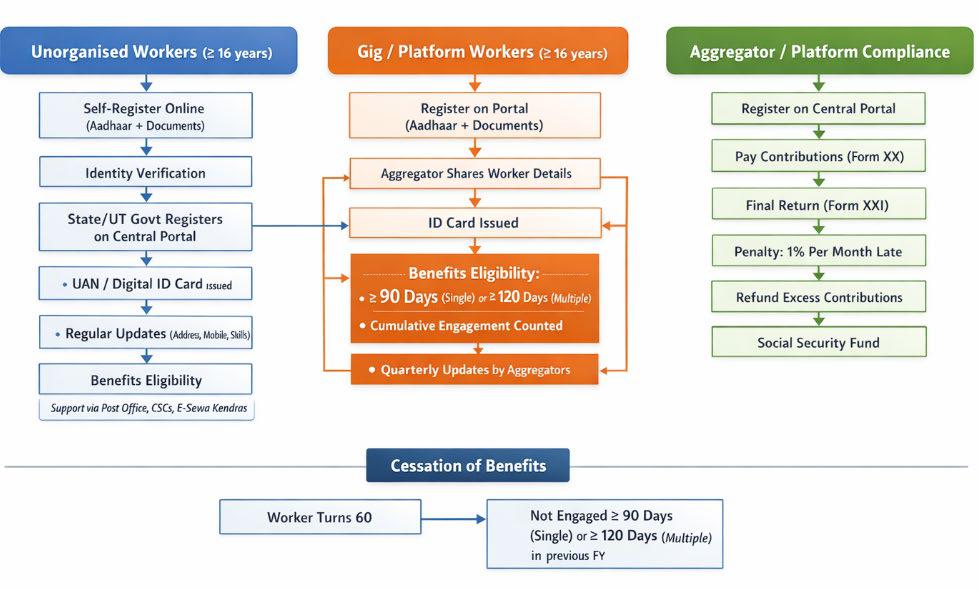
Welfare Schemes for Unorganised Workers: The Central Government is responsible for designing welfare schemes for unorganised workers, including street vendors, domestic workers, small shop employees, and casual labourers. Key areas of coverage include:
- Life and disability cover: Insurance benefits in case of death or permanent disability.
- Health and maternity benefits: Medical insurance and maternity leave support.
- Old age protection: Pensions or other retirement benefits.
- Education: Scholarships or programs for children of workers.
- Other social welfare measures: Additional benefits may be introduced as deemed necessary by the government.
The Central Government determines the specific benefits and structure of these schemes.
Schemes for Gig and Platform Workers Benefits: Central Government schemes for gig and platform workers may include:
- Life and disability cover.
- Accident insurance.
- Health and maternity benefits.
- Old age protection.
- Creche facilities for children.
- Other benefits as deemed necessary.
Schemes specify procedures, implementing agencies, and roles of aggregators (platform companies). Funding sources may include: fully by the government; contributions from aggregators or beneficiaries; a combination of government and private contributions including CSR funds.
State Government Schemes: State Governments can implement complementary welfare schemes for the same group of workers. Benefits may include:
- Provident fund and retirement savings.
- Employment injury benefits for workplace accidents.
- Affordable housing programs.
- Educational initiatives for children.
- Skill upgradation and vocational training.
- Funeral assistance for families of deceased workers.
- Old age homes and shelters for elderly workers.
Central and State schemes are designed to complement each other, ensuring comprehensive welfare coverage.
Funding and Administration of Schemes: Funding for these schemes can be flexible:
- Fully by the government (central or state).
- Jointly by the government and beneficiaries or employers.
- Through other sources such as Corporate Social Responsibility (CSR) funds.
Central schemes require clear administrative guidelines, including scope, eligibility, implementing agencies, resource allocation, and grievance redressal mechanisms. Special Purpose Vehicles (SPVs) may also be established for efficient management.
Funding and Record-Keeping for State Schemes: State welfare schemes may be funded entirely by the State Government, jointly with beneficiaries or employers, or through other sources, including CSR. States can request financial assistance from the Central Government, which decides the terms and duration of such support. Record-keeping is mandatory to maintain transparency and accountability. Authorities must maintain records electronically or physically, with continuous numbering to avoid duplication.
Helpline and Facilitation Centres: To ensure easy access to schemes, governments may establish toll-free call centres and facilitation centres. Functions include:
- Disseminating information on available schemes.
- Assisting with application filing, processing, and forwarding.
- Helping workers with registration and enrolment.
These centres are especially useful for workers unfamiliar with digital or bureaucratic procedures.
G. Employment Information and Monitoring
The provisions on Employment Information and Monitoring require the appropriate Government to mandate certain employers to report vacancies to notified career centres before filling them. This requirement applies only to specified establishments, and the vacancies must be reported in the prescribed form, manner and returns, either electronically or otherwise. However, reporting a vacancy does not create any obligation on the employer to recruit a candidate through the career centre; the objective is only to collect labour market data and facilitate employment services. Authorised officers are empowered to enter premises, inspect records and obtain employment-related information. The requirement does not apply to employment in agriculture (other than plantations), domestic service, or legislative staff. Vacancies lasting less than ninety days and establishments employing fewer than twenty workers are also exempt. Further, vacancies filled through promotion, internal transfer, absorption of surplus staff, recruitment through public recruitment agencies, or posts carrying wages below the notified threshold may also be excluded from reporting.
H. Penalties under the Social Security Code
| Sr. No | Offence | Penalty |
|---|---|---|
| 1 | Failure by employer to pay employees' contribution deducted from wages | Rs.1,00,000 fine + imprisonment (1-3 years) |
| 2 | Failure by employer to pay any contribution under the Code | Rs.50,000 fine + imprisonment (2-6 months) |
| 3 | Failure to pay gratuity due to employee | Up to Rs.50,000 fine or imprisonment up to 1 year, or both |
| 4 | Contravention of ESI or maternity benefit provisions, obstructing Inspector-cum-Facilitator, not producing documents, non-payment of building workers cess, dishonest returns, hazardous process violations | Up to Rs.50,000 fine or imprisonment up to 6 months, or both |
| 5 | Deducting employer's contribution from employee wages, reducing benefits, failing to submit returns/reports, non-payment of compensation, violation of exemption conditions | Up to Rs.50,000 fine |
| 6 | Second or subsequent offence -- failure to pay contribution, cess, gratuity, maternity benefit or compensation | Rs.3,00,000 fine + imprisonment (2-3 years) |
| 7 | Any other second or subsequent offence | Rs.2,00,000 fine + imprisonment up to 2 years |
Key Highlights
a. Facilitative compliance approach: Introduction of the Inspector-cum-Facilitator whose role includes guidance, awareness and assistance to employers and workers, not merely enforcement.
b. Technology-driven inspection system: Web-based inspections, electronic information requests and randomised inspection allocation using unique establishment identification numbers to reduce harassment and discretion.
c. Opportunity to rectify non-compliance: Employers are generally given prior notice and time to correct violations before prosecution (not available for repeated violations within 3 years).
d. Unified electronic registration & records: Single registration number across social security schemes, electronic registers, online returns and digital wage slips permitted to simplify compliance.
e. Time-bound inquiries & limitation period: PF/ESI applicability and dues inquiries barred after 5 years and must generally be completed within 2 years (extendable by 1 year).
f. Institutional & coverage expansion: Creation of national/state social security boards and social security fund covering unorganised, gig and platform workers, along with continuation of EPF, ESI and other organisations.
g. Priority and legal overriding effect: Employee dues (PF, gratuity, maternity, etc.) receive priority in insolvency and the Code overrides inconsistent laws while preserving more beneficial employee entitlements.
What Lies Ahead?
The Code has been brought into force; however, the Rules notified by both the Central Government and the State of Karnataka are presently in the draft stage. Full clarity and operational visibility will emerge only once the final Rules are formally notified and implemented. Several substantive provisions remain non-operational until Notification is issued which includes:
- Notification of the new EPF Scheme, Employees' Pension Scheme and Employees' Deposit Linked Insurance Scheme
- Final notification of contribution rates (10%, 12% or class-specific variations) and pension fund allocation
- Notification of the maximum gratuity ceiling
- Notification of additional events for gratuity payment
- Notification establishing and operationalising the Social Security Fund
- Notification constituting/reconstituting the National Social Security Board
- Schemes for Gig and Platform Workers Benefits
Pacta will continue to track and update developments as notifications are issued.
Industrial Relations Code, 2020
This resource was originally created by Pacta. We’re thankful for the time and care they’ve put into making this information accessible.
You can read the information below in over 15 languages! Simply use the translation tool in the top-left corner of the screen to select your preferred language, including অসমীয়া, বাংলা, ગુજરાતી, हिन्दी, ಕನ್ನಡ, മലയാളം, मराठी, মৈতৈলোন্, नेपाली, ଓଡ଼ିଆ, ਪੰਜਾਬੀ, संस्कृतम्, தமிழ், తెలుగు, and اُردُو.
Background
The Industrial Relations Code, 2020 ("IR Code") has been enacted to amend and consolidate the laws relating to trade unions, conditions of employment in industrial establishments, and investigation and settlement of industrial disputes, with the objective of promoting harmonious industrial relations between employers and workers and ensuring an effective framework for resolution of industrial disputes and matters connected therewith or incidental thereto. The IR Code was passed by the Lok Sabha on September 22, 2020 and subsequently by the Rajya Sabha on September 23, 2020, with a view to amalgamate, simplify and rationalise the provisions of three central labour enactments governing industrial relations, namely the Industrial Disputes Act, 1947, the Trade Unions Act, 1926, and the Industrial Employment (Standing Orders) Act, 1946. The Industrial Relations Code, 2020 has come into force with effect from 21 November 2025.
Note: The Industrial Relations Code may not be applicable to all nonprofits (Section III of this memo offers more clarity)
Laws Subsumed under The Industrial Relation Code, 2020
- The Trade Unions Act, 1926
- The Industrial Employment (Standing Orders) Act, 1946
- The Industrial Disputes Act, 1947
Key Features of the Industrial Relations Code, 2020
-
Simplification of Compliance Mechanism: The Industrial Relations Code, 2020 simplifies labour law compliance by reducing the number of rules, forms, and registers and enabling digital filings and electronic record-keeping. This minimises procedural complexity, enhances transparency, and reduces administrative burden for establishments while improving regulatory efficiency.
-
Expanded and Uniform Definition of Worker: The Code broadens the definition of "worker" to include sales promotion employees, working journalists, and supervisory employees earning up to Rs.18,000 per month. This expansion ensures that a wider section of employees gains access to labour protections, statutory benefits, and dispute resolution mechanisms.
-
Expansion of the Definition of Industry: The definition of "industry" now includes any systematic activity carried out through cooperation between employers and workers, irrespective of profit motive or capital investment.
-
Uniform Definition of Wages: A standardised definition of wages has been introduced with a 50% cap on exclusions, ensuring that statutory benefits such as gratuity, retrenchment compensation, and social security contributions are calculated on a fair portion of total earnings. This reduces wage manipulation and disputes relating to benefit calculations.
-
Statutory Recognition of Trade Unions: The Code provides a structured mechanism for recognition of trade unions through the concept of a Negotiating Union or Negotiating Council. A union with 51% membership is recognised as the sole negotiating body, strengthening collective bargaining and promoting structured employer-employee dialogue.
-
Introduction of Fixed-Term Employment: Fixed-Term Employment allows employers to engage workers for a specific duration through written contracts while ensuring parity with permanent employees in wages, working conditions, and statutory benefits. Fixed-term employees also become eligible for gratuity upon completion of one year of service.
-
Regulation of Strikes and Lockouts: The Code mandates a 14-day prior notice before strikes or lockouts in all establishments and restricts such actions during conciliation and tribunal proceedings. The inclusion of mass casual leave within the definition of strike discourages sudden work stoppages and promotes negotiated settlement of disputes.
-
Streamlined and Time-Bound Dispute Resolution Mechanism: Industrial disputes are addressed through two-member Industrial Tribunals consisting of judicial and administrative members to ensure faster adjudication. Parties may directly approach the tribunal if conciliation fails within a prescribed period, reducing delays in dispute resolution.
-
Decriminalisation and Compounding of Offences: Several minor offences under the Code have been decriminalised and made compoundable through payment of monetary penalties. This shifts enforcement from punitive prosecution to compliance-based regulation, enabling quicker resolution while reducing litigation burdens.
-
Retrenchment Flexibility with Worker Protection Measures: The threshold requiring prior government approval for lay-off, retrenchment, and closure has been increased to establishments employing 300 or more workers, providing operational flexibility to industries. At the same time, the Worker Re-Skilling Fund ensures financial assistance and skill development support for retrenched workers.
-
Gender Representation and Work Flexibility: The Code mandates adequate representation of women in Grievance Redressal Committees proportional to their workforce participation and enables work-from-home provisions under Model Standing Orders, promoting inclusive and flexible employment practices.
-
Digitalisation of Industrial Relations Processes: The Code enables electronic registration, filing of returns, maintenance of records, and online communication with authorities. Digital systems enhance transparency, reduce paperwork, and ensure faster compliance and administrative efficiency.
Does a Not-for-Profit organisation (NPO) have to comply with the Industrial Relations Code?
The answer depends on whether the specific not-for-profit organisation qualifies as an "industry" under Section 2(p) of the Industrial Relations Code, 2020.
A. Definition of industry as Section 2(p) of Industrial Relations code
"industry" means any systematic activity carried on by co-operation between an employer and worker (whether such worker is employed by such employer directly or by or through any agency, including a contractor) for the production, supply or distribution of goods or services with a view to satisfy human wants or wishes (not being wants or wishes which are merely spiritual or religious in nature), whether or not -- (i) any capital has been invested for the purpose of carrying on such activity; or (ii) such activity is carried on with a motive to make any gain or profit, but does not include -- (i) institutions owned or managed by organisations wholly or substantially engaged in any charitable, social or philanthropic service; or (ii) any activity of the appropriate Government relatable to the sovereign functions of the appropriate Government including all the activities carried on by the departments of the Central Government dealing with defence research, atomic energy and space; or (iii) any domestic service; or (iv) any other activity as may be notified by the Central Government;
Thus "industry" is any systematic activity carried on by cooperation between an employer and workers (whether directly employed or through an agency/contractor) for the production, supply or distribution of goods or services to satisfy human wants or wishes (other than purely spiritual or religious wants), irrespective of capital investment or profit motive.
However, the definition expressly excludes:
- Institutions owned or managed by organisations wholly or substantially engaged in charitable, social or philanthropic services;
- Sovereign functions of the Government (including defence research, atomic energy and space);
- Domestic service; and
- Any other activity notified by the Central Government.
Application to Not-for-Profit Organisations
A Not-for-Profit organisation will qualify as an "industry" if:
- It carries on a systematic and organised activity;
- There exists an employer-worker relationship;
- It provides goods or services to satisfy human wants (other than purely religious/spiritual purposes); and
- It does not fall within the charitable/philanthropic exclusion.
Whether the organisation makes a profit or not is not considered while deciding if it is an industry under the Industrial Relations Code, 2020.
Effect of the Charitable Exclusion
Under Section 2(p), institutions owned or managed by organisations wholly or substantially engaged in charitable, social, or philanthropic service are excluded. Therefore:
- If the NPO is wholly or substantially charitable in character, it may fall outside the definition of "industry."
- If the organisation operates in a structured, service-delivery manner employing workers and is not substantially charitable in nature, it may still be treated as an industry.
The determination will depend on:
- The dominant nature of activities;
- The organisational structure;
- The presence of an employment relationship; and
- Whether the charitable element is substantial.
Interpretational challenge
The Code does not prescribe clear criteria for determining what constitutes "charitable" or "philanthropic" activity. Therefore, the assessment is fact-specific and depends on the dominant nature of functions, organisational structure, and the extent to which activities resemble organised service delivery rather than pure charity. Consequently, classification must be evaluated on a case-by-case basis.
A Not-for-Profit organisation does not automatically fall outside the definition of "industry" under Section 2(p) of the Industrial Relations Code, 2020. It will qualify as an industry where it carries on systematic service activities through employer-worker cooperation, unless it is wholly or substantially engaged in charitable, social, or philanthropic services falling within the statutory exclusion. See Illustrations for more clarity.
Illustration 1: NPO Classified as an "Industry"
A registered non-profit organisation operates vocational training centres for craft and art products in multiple cities.
- Training and skilling programmes are delivered systematically to trainees.
- The products produced are sold in stores -- online and offline.
- The organisation receives funding through grants, CSR partnerships, and course fees from certain beneficiaries.
- Services are aimed at improving employability and livelihood opportunities.
- Operations resemble organised manufacturing and service delivery with defined employment hierarchies and performance systems.
Legal Position
This training centres and manufacturing units are likely to be classified as an industry because:
- There is a systematic and organised activity
- Employer-worker relationship exists
- Services satisfy human wants (handicraft products are produced)
- Activity is sale-oriented rather than purely charitable
- The organisation may be engaged in charity, but the manufacturing unit produces products for sale.
Illustration 2: NPO Not Classified as an "Industry"
A charitable trust runs a community relief centre that distributes free food, clothing, and emergency aid during disasters.
- Activities are largely volunteer-driven.
- No structured commercial-style operations exist.
- Services are provided entirely free of cost.
- The dominant purpose is humanitarian relief and philanthropy.
This NPO would likely not qualify as an industry because:
- The organisation is wholly engaged in charitable and philanthropic service
- Activities fall within the charitable exclusion under Section 2(p)
- Absence of structured employer-worker industrial organisation
- Dominant character is relief-based charity rather than organised production or service delivery
B. Earlier Legal Position under the Industrial Disputes Act, 1947
Section 2(j) of the Industrial Disputes Act, 1947 defines "industry" as:
"Any business, trade, undertaking, manufacture or calling of employers and includes any calling, service, employment, handicraft, or industrial occupation or avocation of workmen."
The definition is broad and inclusive, focusing on the nature of the activity rather than the motive behind it. The definition in its preliminary reading does not exclude non-profits.
Landmark Interpretation: Bangalore Water Supply Case
Bangalore Water Supply and Sewerage Board vs. A. Rajappa
This seven-judge bench decision remains the leading authority on the interpretation of "industry." The Court laid down the Triple Test to determine whether an activity qualifies as an industry:
- Systematic activity
- Cooperation between employer and employee
- Production or distribution of goods or services to satisfy human needs
If these three elements are satisfied, the activity constitutes an "industry."
Key Principles Laid Down
- Profit motive is irrelevant.
- Charitable purpose is irrelevant.
- The focus is on the functional and organisational aspects of the activity.
- The relationship between employer and employee is central.
- Religious or spiritual services aimed purely at spiritual fulfilment are excluded.
The Court held that non-profit and charitable organisations are not automatically excluded from the definition. Thus, hospitals, schools, and welfare institutions may qualify as industries if they satisfy the Triple Test. However, this position is pending Reconsideration by the Supreme Court:
- In State of Uttar Pradesh vs. Jai Bir Singh, a Constitution Bench referred the correctness of Bangalore Water Supply to a larger bench.
- In 2017, a seven-judge bench indicated that the matter would be placed before a nine-judge Constitution Bench.
- A Bench led by Chief Justice Surya Kant (along with Justices Joymalya Bagchi and V.M. Pancholi) has scheduled arguments from 17-18 March 2026 to reconsider the scope of Section 2(j).
The decision is expected to clarify long-standing confusion regarding the applicability of the Act to governmental and non-profit institutions.
C. Comparative Analysis: Classification of Not-for-Profit Organisations (NPOs) as an "Industry"
| Parameter | Position under the Industrial Disputes Act, 1947 (Earlier Regime) | Position under the Industrial Relations Code, 2020 (Present Regime) | Analytical Shift |
|---|---|---|---|
| Legislative Approach | Broad and open-ended statutory definition shaped primarily through judicial interpretation. | Definition legislatively refined with express inclusions and exclusions. | Shift from judge-made expansion to statutory structuring. |
| Core Basis of Determination | Functional nature of activity was decisive. | Functional activity examined along with statutory exclusions. | Movement from activity-based test to activity + institutional character test. |
| Governing Legal Test | Triple Test laid down in Bangalore Water Supply and Sewerage Board vs. A. Rajappa (systematic activity, employer-employee cooperation, service to human needs) but yet the position is unsettled | No judicial test prescribed; determination depends on dominant nature of organisation and applicability of charitable exclusion under Section 2(p). | Judicial test replaced by dominant nature statutory assessment. |
| Relevance of Profit Motive | Profit motive held irrelevant; even non-profit bodies could be industries. | Profit motive expressly irrelevant under statute. | Continuity maintained -- labour protection not linked to profit. |
| Treatment of NPOs | NPOs generally included if organisational activity satisfied Triple Test. | NPOs conditionally included; excluded if wholly or substantially charitable, social, or philanthropic. | Introduction of qualified exclusion for NPOs. |
| Employer-Employee Relationship | Central determining factor; existence of organised labour usually sufficient. | Still relevant but insufficient if charitable exclusion applies. | Employment relationship no longer automatically decisive. |
| Government / Welfare Institutions | Frequently included unless performing strictly sovereign functions (e.g., hospitals included in industry). | Sovereign and substantially charitable functions expressly excluded. | Legislative narrowing of earlier expansive inclusion. |
| Degree of Coverage of Labour Laws | Wide coverage -- most organised service institutions fell within industrial regulation. | Potentially narrower coverage depending on charitable character. | Possible reduction in regulatory reach over NPO sector. |
What Lies Ahead?
Under the Industrial Relations Code, 2020, Not-for-Profit Organisations are not automatically excluded from the definition of industry. While the Code introduces a statutory exclusion for institutions wholly or substantially engaged in charitable, social, or philanthropic activities, classification ultimately depends on the dominant nature of activities and the operational structure of the organisation. However, interpretational ambiguity continues to persist, particularly in assessing what constitutes "substantial" charitable activity, pending further judicial clarification.
Importantly, the scope of the term "industry" is presently under reconsideration before the Supreme Court in the case of State of Uttar Pradesh vs. Jai Bir Singh. The pending reference raises, inter alia, the following significant questions:
- Whether the Triple Test formulated in paragraphs in Bangalore Water Supply correctly lays down the law for determining whether an undertaking or enterprise falls within the definition of industry?
- Whether the Industrial Disputes (Amendment) Act, 1982 -- which was enacted but never brought into force and the coming into effect of the Industrial Relations Code, 2020 (effective from 21 November 2025) have any legal impact on the interpretation of the expression "industry" under the parent legislation?
- Whether social welfare activities, governmental schemes, or enterprises undertaken by Government departments or their instrumentalities can be construed as industrial activities within the meaning of Section 2(j) of the Industrial Disputes Act?
The outcome of this reference is expected to have a long-standing and decisive impact on the classification of welfare institutions, governmental bodies, and particularly Not-for-Profit Organisations, in determining whether they fall within the ambit of an industry for labour law purposes.
On the other hand, the Code has been brought into force; however, the Rules notified by both the Central Government and the State of Karnataka presently remain in the draft stage. Full clarity and operational visibility are expected to emerge only upon formal notification and implementation of the final Rules.
Pacta will continue to track regulatory developments and provide updates as and when further clarity evolves.
Occupational Safety, Health and Working Conditions Code, 2020
This resource was originally created by Pacta. We’re thankful for the time and care they’ve put into making this information accessible.
You can read the information below in over 15 languages! Simply use the translation tool in the top-left corner of the screen to select your preferred language, including অসমীয়া, বাংলা, ગુજરાતી, हिन्दी, ಕನ್ನಡ, മലയാളം, मराठी, মৈতৈলোন্, नेपाली, ଓଡ଼ିଆ, ਪੰਜਾਬੀ, संस्कृतम्, தமிழ், తెలుగు, and اُردُو.
Background
The Occupational Safety, Health and Working Conditions Code, 2020 ("OSH Code") has been enacted to amend and consolidate the laws relating to occupational safety, health, and working conditions with the objective of ensuring safe and healthy workplaces for all workers, whether in factories, mines, plantations, or other establishments, and for matters connected therewith or incidental thereto. The OSH Code was passed by the Lok Sabha on September 22nd, 2020 and subsequently by the Rajya Sabha on September 23rd, 2020, with a view to amalgamate, simplify and rationalise the provisions of 13 central labour enactments relating to safety, health, and welfare. The OSH Code has come into force with effect from 21 November 2025.
Laws subsumed under the OSH Code:
- The Factories Act, 1948
- The Plantations Labour Act, 1951
- The Mines Act, 1952
- The Working Journalists and Other Newspaper Employees (Conditions of Service) and Miscellaneous Provisions Act, 1955
- The Working Journalists (Fixation of Rates of Wages) Act, 1958
- The Motor Transport Workers Act, 1961
- The Beedi and Cigar Workers (Conditions of Employment) Act, 1966
- The Contract Labour (Regulation and Abolition) Act, 1970
- The Sales Promotion Employees (Conditions of Service) Act, 1976
- The Inter-State Migrant Workmen (Regulation of Employment and Conditions of Service) Act, 1979
- The Cine-Workers and Cinema Theatre Workers (Regulation of Employment) Act, 1981
- The Dock Workers (Safety, Health and Welfare) Act, 1986
- The Building and Other Construction Workers (Regulation of Employment and Conditions of Service) Act, 1996
Comparison of Key Legal Provisions between Old Regimes and OSH Code 2020
| Feature | Old Labour Laws | Occupational Safety, Health and Working Conditions Code, 2020 | Impact |
|---|---|---|---|
| Applicability | Applicable to specified threshold limit requirement under various Act. | Applicable to establishments employing 10+ workers in all mines and docks and includes commercial establishments. | More establishments come within the mandate of OSH Code |
| Establishment | Different definitions across laws; largely limited to factories and specific sectors | Uniform definition covering all establishments with >=10 workers, including commercial establishments | Expands applicability to IT/ITeS and service sector; broader compliance burden |
| Factory | 10+ for manufacturing process with power and 20+ for without power | 20+ for manufacturing process with power and 40+ for without power | Increase in hiring of employees for factories |
| Registration | 13 different registrations under various Acts separately | Electronic registration by the employer of the establishment, 1 single registration. | Ease of registration and conducting business for employer |
| Returns | 16 different returns | 1 annual return | Ease of filing returns |
| Working Hours | 9 hrs per day, 48 hrs per week | 8-12 hrs per day, 48 hrs per week | Shorter standard workday with consent-based overtime |
| Annual Leave | Eligibility as per Factories Act after working 240 days, Accrual Rate of 1/20 | Eligibility after working 180 days, Accrual Rate of 1/20 | Increases employees and expands applicability to a wider range of establishments who will be eligible for leave |
| Leave Encashment | Was primarily allowed when a worker was discharged, dismissed, retired, etc. | Any leave days in excess of 30 days shall be encashed mandatorily. It is payable within 2 days from the date of discharge/resignation and 2 months where separation is due to death or superannuation. | Mandatory duty of encashment of excess leaves increasing payroll |
| Weekly Holidays | Present but fragmented across laws | Max 6 working days/week; compensatory leave mandated | Uniform leave entitlement |
| Audio-Visual Worker | Lacked specific and comprehensive provisions for Audio-Visual Workers. | Code prohibits the employment of Audio-visual workers unless an agreement in writing is registered with competent authority. | Requirement of an agreement to avoid exploitation of such workers. |
| Welfare Officer | Appointment in every factory wherein 500 workers are ordinarily employed | Appointment in every factory, mine or plantation wherein 250 workers are ordinarily employed | Duty on employer to appoint such officer when it meets threshold |
| Advisory Boards | 6 different advisory boards under 6 different Acts | 1 Single Advisory Board named National Occupational Safety and Health Advisory Board | Ease of Implementation |
| Creche Facilities | Available only when there are 30+ woman workers | Available when there are 50+ total workers employed. | Gender-neutral provision and heavy cost implications |
| Core Activity | Not defined | Defined as activities for which the establishment is set up, including those essential or necessary to it | Brings clarity, reduces interpretational disputes, and forms the basis for restricting contract labour in core functions |
| Contract Labour Threshold | 20 workers triggered applicability | 50 workers trigger applicability | Smaller contractors exempt from compliance burden |
| Work-Specific License | Annual license for contractor | Work-specific license (can be for specific duration/project) | More flexible licensing for project-based work |
| Women Night Shifts | No woman shall be allowed to work except between 6 A.M. and 7 P.M. | Women are permitted to work night shifts and in all types of work (including underground mining and heavy machinery), subject to their consent and mandatory safety measures. | Can allow for night shifts with express consent and safety measures. Duty on employers to secure them for flexible staffing. This paves way to Greater employment opportunities for women |
| Health Check-Ups | Limited to hazardous workers only | Employers must provide all workers above the age of 40 years with a free annual health check-up. | Increases costs for medical camps and maintains unified health records. |
| Inter-State Migrant Registration | Employer-registered system | Self-declaration via Aadhaar, portable benefits | Simplified process with benefit portability |
| Journey Allowance for Migrants | Not standardised | Annual journey allowance (not one-time) | Recurring benefit for migrant workers |
| Employer Duties (Health & Safety) | Primarily under Factories Act | Extended to all establishments >=10 workers | Extended to all establishments >=10 workers |
| Health & Safety Rights of Employees | Limited express rights | Limited express rights | Limited express rights |
| Reporting of Accidents/Diseases | Applicable mainly to factories | Applicable mainly to factories | Applicable mainly to factories |
| Welfare Facilities | Mandatory mainly for factories | Mandatory mainly for factories | Mandatory mainly for factories |
| Penalties | Imprisonment of 2 years or Fine of Rs.1,00,000 or both with further penalty of Rs.1,000 per day for continuous contravention. | Fine of Rs.2,00,000 extendable to Rs.3,00,000 with further penalty of Rs.20,000 per day for continuous contravention. Allows for compounding of offences. | Decriminalised as no imposition of imprisonment but higher fines. |
Categories of Employment under the OSH Code
The Occupational Safety, Health and Working Conditions Code classifies workers and employees into distinct categories based on the nature of work, mode of engagement, and sector of employment. This categorisation is significant as it determines the applicable wage structures, statutory benefits, and working conditions, including safety, social security, and welfare entitlements. The table below outlines the key categories along with their definitions and corresponding wages and benefits.
- Part I -- Core Categories: Covers the primary classifications (Worker, Employee, Contract Labour) that determine the general applicability of wages, protections, and working conditions under the Code.
- Part II -- Specialised Categories: Focuses on sector-specific roles with tailored provisions addressing industry-specific working conditions and welfare needs.
Part I
| Classification | Definition | Wages & benefits | Exclusions |
|---|---|---|---|
| Worker | Person employed in any establishment to do any manual, unskilled, skilled, technical, operational, clerical or supervisory work for hire or reward, whether the terms of employment be expressed or implied and includes working journalists and sales promotion employees. | Applicable to workers earning wages up to Rs.18,000 per month. Entitled to protections in cases of lay-off, including prior notice and related safeguards. Eligible to be part of workplace safety committees, where constituted. Overtime must be compensated at twice the ordinary rate of wages (2x pay). | Excludes members of Armed Forces; Police service as officer or employee of prison; person employed mainly in a managerial or administrative capacity and person employed supervisory capacity drawing wages exceeding Rs.18,000 per month. |
| Employee | Establishment: Person other than Apprentice employed on wages by an establishment to do any skilled, semi-skilled, unskilled, manual, operational, supervisory, managerial, administrative, technical, clerical or any other work, whether the terms of employment be expressed or implied. Mine: Person is "employed" in a mine who works as the manager or who works under appointment by the owner, agent or manager of the mine or with the knowledge of the manager, whether for wages or not in any mining operation and any kind of work connected with mining operations. | "Wages" definition applies universally (>=50% basic+DA). All OSH benefits such as registration, leave, creche, health checks, and safety measures apply to employees. | Excludes Apprentices under the Apprentices Act, 1961 and the members of the Armed Forces of the Union but includes employees declared by appropriate government. |
| Contract Labour | Worker who shall be deemed to be employed in or in connection with the work of an establishment when he is hired in or in connection with such work by or through a contractor with or without the knowledge of the principal employer. | Workers get periodical increment in the pay, social security coverage and other welfare benefits in accordance with the law for the time being in force in such employment. | It includes inter-State migrant workers but does not include a worker (other than part time employee) who is regularly employed by the contractor for any activity of his establishment and his employment is governed by mutually accepted standards of the conditions of employment (including engagement on a permanent basis). |
Part II
| Classification | Definition | Wages & benefits | Exclusions |
|---|---|---|---|
| Audio-Visual Worker | Person employed in connection with audio-visual production to work as an artist including actor, musician, singer, anchor, news reader, dancer, dubbing artist or stunt person or to do any work, skilled, unskilled, manual, supervisory, technical, artistic or otherwise. | Such remuneration does not exceed where remuneration is by way of monthly wages or where such remuneration is by way of lump sum, in each case, such amount as may be notified by the Central Government. | Excludes persons employed with pure managerial roles. |
| Building Worker | Person employed to do any highly skilled, skilled, semi-skilled or unskilled, manual, technical or clerical work for hire or reward. The terms of such employment are express or implied in connection with any building or other construction work. | Minimum wages + journey allowance for migrants; "wages" for PF/ESI. Benefits such as Safety gear, ESI, accident compensation, rest shelters | Does not include any such person who is employed mainly in a managerial or supervisory or administrative capacity. |
| Motor Transport Worker | Person employed in a motor transport undertaking directly or through an agency, whether for wages or not, to work in a professional capacity on a transport vehicle or to attend the duties in connection with the arrival, departure, loading or unloading of such transport vehicle. It includes a driver, conductor, cleaner, station staff, line checking staff, booking clerk, cash clerk, depot clerk, time-keeper, watchman or attendant. | Workers are entitled to statutory minimum wages, with overtime payable for extra hours; fatigue rules must be followed. Maximum of 8 hours of continuous work, with mandatory rest intervals. Eligible for PF (Provident Fund) and ESI (Employee State Insurance) benefits, as applicable. Requirement of valid fitness certificates to ensure workers are medically fit. Provision for insurance/compensation in case of workplace accidents. | Excludes persons employed in a factory and persons to whom conditions of service of persons employed in shops or commercial establishments apply. |
| Sales Promotion Employee | Person employed or engaged in any establishment for hire or reward to do any work relating to promotion of sales or business or both. | Commission is treated as part of wages; employees are entitled to minimum wages along with applicable incentives. Safeguards relating to working hours, leave, and service conditions apply to such employees. Standing orders govern terms of employment, including conduct, discipline, and conditions of service. | Does not include persons employed supervisory capacity drawing wages exceeding Rs.18,000 per month and persons employed or engaged mainly in a managerial or administrative capacity. |
| Working Journalist | Person whose principal vocation is that of a journalist and who is employed as such, either whole-time or part-time in relation to one or more newspaper establishments or other establishments relating to any electronic media or digital media such as newspaper or radio or other like media. Includes an editor, a leader-writer, news editor, sub-editor, feature-writer, copy tester, reporter, correspondent, cartoonist, news-photographer and proof-reader. | Basic Pay + Dearness Allowance (DA), subject to the 50% rule. Determined through special wage boards. Maximum of 144 working hours over a period of 4 weeks. Entitled to gratuity and leave benefits at par with other workers. | Excludes any such person who is employed mainly in a managerial, supervisory or administrative capacity. |
| Inter-State Migrant Worker | A person who: is recruited in one State and employed in another; or migrates on their own and secures employment in another State; must earn wages up to Rs.18,000 per month (or higher as notified by the Central Government). | Entitled to all benefits available to other workers in the establishment (including PF/ESI, medical facilities). Employer/contractor must ensure suitable working conditions considering out-of-state employment. Mandatory reporting of fatal/serious accidents to authorities of both States and next of kin. Annual to-and-fro travel allowance to native place. Option to access public distribution system in either native or destination State. Access to benefits (e.g., construction cess fund) in destination State. Provision for toll-free helpline and welfare schemes by Government. | Not applicable to workers earning above Rs.18,000 per month (unless revised by notification). |
Key Definitions
-
Contractor: A "contractor", in relation to an establishment, refers to a person who undertakes to produce a given result through the engagement of contract labour or supplies contract labour as a human resource for any work of the establishment. This definition is broad and also includes sub-contractors, thereby covering layered contracting arrangements.
-
Core Activity of an Establishment: "Core activity" refers to the primary activity for which an establishment is set up, including activities that are essential or integral to such primary function. However, the Code clarifies that certain support, or ancillary services will not be treated as core activities unless the establishment is specifically set up for them. These include:
- sanitation and cleaning services
- security/watch and ward services
- canteen and catering
- loading and unloading
- support services such as hospitals, guest houses, training institutions
- courier services
- construction and maintenance work
- gardening and housekeeping
- transport services (including ambulance)
- intermittent activities
This distinction is important, particularly in determining the permissibility of engaging contract labour in core versus non-core activities.
-
Employer: An "employer" means any person who employs one or more employees, either directly or through another person, in an establishment. The definition is intentionally wide and varies based on the nature of the establishment. It includes:
- the occupier in case of a factory
- the owner, agent, or manager in case of a mine
- the person or authority having ultimate control over the establishment (including a manager or managing director)
- a contractor
- the legal representative of a deceased employer
- in government establishments, the designated authority or head of department
-
Establishment: An "establishment" broadly refers to any place where economic or commercial activity is carried on with a threshold of ten or more workers. It includes:
- places engaged in industry, trade, business, manufacturing, or occupation
- motor transport undertakings, newspaper establishments, audio-visual production units, construction work, and plantations
- factories (for specific chapters)
- mines and ports or dock work areas
The threshold of workers may be relaxed in cases involving hazardous or life-threatening activities, as notified by the Central Government.
-
Wages: "Wages" refers to all remuneration expressed in monetary terms payable to an employee in respect of employment or work done, provided the terms of employment are fulfilled. Included components: basic pay, dearness allowance, retaining allowance (if any). Excluded components: bonus (not forming part of contractual remuneration), employer contributions to PF/pension, house rent allowance, conveyance allowance, overtime allowance, commission, gratuity and retrenchment benefits, any sum paid to meet employment-related expenses. Key rule: If excluded components (except certain specified items) exceed 50% of total remuneration, the excess is deemed part of wages. Certain allowances (like conveyance, HRA, etc.) are still considered for equal wage computation. Remuneration in kind (up to 15% of total wages) is included in wages.
Implication of The OSH Code, 2020 for Non-profit Organisations
A. Registration
Applicability and Requirement: The Code mandates that every employer of an establishment employing 10 or more employees, to which the provisions of the Code apply, must obtain registration within sixty days from the date the Code becomes applicable to such establishment, if not already registered. The registration is required to be made electronically before the registering officer. While the requirement is mandatory, delayed applications may still be entertained upon payment of prescribed late fees, thereby providing limited flexibility in compliance. The application can be made electronically in Form-I on the Shram Suvidha Portal of the Ministry of Labour & Employment or designated Portal.
Application Process and Particulars: The application for registration must be submitted in the prescribed form, manner and along with the requisite fees. It is required to contain detailed particulars of the establishment, including information relating to the employment of inter-State migrant workers. This ensures a standardised and comprehensive database of establishments and workforce composition under the Code.
Grant of Registration and Deemed Approval: Upon receipt of the application, the registering officer is required to issue a certificate of registration electronically within the prescribed time and subject to prescribed conditions. A significant reform under the Code is the concept of deemed registration. In cases where the registering officer fails to act within the stipulated timeline, the establishment is automatically deemed to be registered, and the certificate is auto generated. This reduces administrative delays and limits discretionary inaction.
Amendment of Registration: Post-registration, any change in ownership, management or other particulars furnished at the time of registration must be intimated electronically within thirty days. Upon such intimation, the registering officer is required to amend the registration certificate accordingly. This ensures that regulatory records remain accurate and up to date.
Is cancellation of registration allowed? Yes, registration can be cancelled, especially if obtained through false information. The employer must be given a 30-day opportunity to show cause before cancellation is affected.
Closure of Establishment: In the event of closure, the employer is required, within thirty days, to notify the registering officer and certify that all dues payable to workers have been settled. The registering officer must cancel the registration within sixty days of such intimation. Similar to registration, the Code provides for deemed cancellation where the authority fails to act within the prescribed timeline, ensuring closure formalities are not indefinitely delayed.
Revocation of Registration: The Code provides for revocation of registration in cases where it has been obtained fraudulently, through misrepresentation, or suppression of material facts, or where it has otherwise become ineffective. While misrepresentation is treated as a contravention attracting penalties, revocation in substantive cases can be carried out only after giving the employer an opportunity of being heard and must be completed within sixty days.
Prohibition on Employment without Registration: A critical compliance requirement under the Code is that no employer shall employ any worker in an establishment that is not registered, or where the registration has been cancelled or revoked and no appeal is pending. Registration thus becomes a pre-condition for lawful operation of establishments.
Deemed Registration for Existing Establishments: To facilitate transition, establishments already registered under any Central labour law or other notified law are deemed to be registered under the Code. However, such establishments are required to furnish their existing registration details to the registering officer within the prescribed time and manner.
Appeal Mechanism: Any person aggrieved by an order relating to registration may file an appeal within thirty days before the designated appellate authority. The authority may condone delays for sufficient cause and is required to dispose of the appeal within thirty days, ensuring time-bound adjudication.
Notice of Commencement and Cessation: In addition to registration, certain categories of establishments -- such as factories, mines, contract labour establishments and construction establishments -- are required to provide prior electronic notice before commencement of operations and to intimate cessation of operations. This requirement enables regulatory oversight and tracking of industrial activity.
B. Duties of Employer and Employees
General Duties of Employer: The Code places a primary and overarching obligation on every employer to ensure that the workplace is free from hazards that may cause injury or occupational disease. Employers are required to comply with prescribed occupational safety and health standards and maintain a working environment that is safe and without risks to employee health, so far as reasonably practicable. This includes responsibility for:
- Provide free annual health examinations for employees above 40 years across all establishments, workers engaged in hazardous factory workers in establishments with 10 or more employees including those exposed to occupational risks and contract labour, as well as workers in sectors such as mines, plantations, docks, building and construction, and motor transport.
- Ensuring safe disposal of hazardous and toxic waste, including e-waste
- Issuing appointment letters to all employees (Refer Annexure I for format)
- Ensuring that no cost is charged to employees for safety measures or medical examinations
In high-risk sectors such as factories, mines, construction and plantations, the employer's duty extends beyond employees to all persons present at the workplace, whether authorised or not.
Specific Safety Obligations: In addition to the general duty, employers are required to take specific measures to ensure workplace safety. These include maintaining safe plant and systems of work, ensuring safe handling, storage and transport of substances, and providing adequate training, supervision and information to employees. Employers must also ensure:
- Safe access to and exit from workplaces
- Continuous monitoring of working conditions
- Adequate welfare facilities
These provisions collectively impose a proactive and preventive safety obligation, rather than a reactive one.
Duties of Designers, Manufacturers and Suppliers: The Code extends safety obligations beyond the employer to include all persons involved in the supply chain of equipment and substances. Designers, manufacturers, importers and suppliers are required to ensure that articles and substances are safe when properly used and do not pose risks to workers' health. They are also required to:
- Conduct necessary testing and examination
- Provide adequate information and usage instructions
- Ensure compliance with applicable safety standards (including for imported goods)
This ensures that workplace safety is embedded at the design and production stage itself.
Reporting Obligations (Accidents, Occurrences, Diseases): The Code imposes strict reporting requirements on employers to ensure regulatory oversight. Employers must notify the appropriate authority in case of:
- Accidents causing death or serious injury (leading to absence of 48 hours or more)
- Dangerous occurrences, even if no injury occurs
- Occupational diseases specified in the Schedule
Additionally, medical practitioners are also required to report notified occupational diseases, ensuring early detection and accountability.
Duties of Employees: Employees are also subject to statutory duties and are required to take reasonable care for their own safety and that of others. They must comply with safety standards, cooperate with the employer, and report unsafe conditions. Employees are specifically required to:
- Not misuse or interfere with safety equipment
- Not engage in acts that may endanger themselves or others
- Report hazards promptly
This establishes a shared responsibility model for workplace safety.
Rights of Employees: The Code recognises that safety is not only a duty but also a right. Employees are entitled to obtain information relating to workplace safety and may raise concerns either directly or through safety committees. Where there is a reasonable apprehension of imminent danger, employees have the right to:
- Report the situation immediately
- Seek remedial action
- Escalate the issue to the Inspector-cum-Facilitator if unresolved
The employer is required to take immediate action or refer the matter to the authority, whose decision is final.
Prohibition on Misuse of Safety Measures: The Code expressly prohibits any person from intentionally or recklessly interfering with or misusing anything provided for health, safety or welfare at the workplace. This reinforces the integrity of safety systems.
C. Health, Safety and Working Conditions
Employer Responsibility: The Code places a primary obligation on the employer to ensure that adequate health, safety and working conditions are maintained in the establishment, as may be prescribed by the Central Government. This is a broad, enabling provision which allows the Government to standardise workplace conditions across sectors.
Core Workplace Conditions: Without limiting the general obligation, the Code specifically requires employers to ensure essential workplace standards relating to hygiene, safety and environment. These include:
- Cleanliness and maintenance of hygiene
- Proper ventilation, temperature and humidity control
- Work environment free from dust, fumes, gases and impurities
- Availability of safe drinking water
- Prevention of overcrowding with adequate space
- Adequate lighting
- Separate and hygienic sanitation facilities for male, female and transgender employees
- Proper disposal of waste and effluents
These provisions collectively aim to ensure a safe, dignified and healthy working environment.
D. Welfare Provisions
General Welfare Measures: In addition to safety and health, the employer is required to provide welfare facilities necessary for ensuring a decent standard of life for employees. These include basic amenities such as washing facilities, bathing places, locker rooms and suitable arrangements for employees who are required to work in a standing position. Canteen facilities are mandatory in establishments employing 100 or more workers, including contract labour. Further, first-aid facilities must be readily available during working hours, and specific sectors such as mines require periodic medical examinations of workers.
Additional Welfare Requirements: The Central Government may prescribe additional welfare measures depending on the nature and size of the establishment. Key requirements include:
- Ambulance room in establishments with 500 or more workers
- Restrooms, shelters and lunchrooms in establishments with 50 or more workers
- Appointment of welfare officer in establishments with 250 or more workers
- Provision of protective gear and facilities for specific sectors such as transport workers
- Temporary accommodation for construction workers near the worksite
Where work is carried out through contractors, the principal employer may also bear responsibility for certain welfare-related expenses.
E. Hours of Work and Annual Leave with Wages
Working Hours: The Code limits working hours to ensure safety and prevent fatigue. No worker shall be required or allowed to work for more than 8 hours in a day, with intervals and spread over as prescribed. Special provisions apply:
- Mines: Separate daily hour limits; mandatory shift system; presence restricted to recorded shift hours.
- Motor Transport Workers: Working hours include running time, subsidiary work, and short attendance periods.
Certain categories have exceptions:
- Working journalists: Max 144 hours over 4 weeks + minimum 24-hour weekly rest.
- Sales promotion employees/journalists: Entitled to earned leave, medical leave, accumulation, encashment, and compensation on termination or death.
- Adolescent workers: Governed by separate child labour law.
Weekly Holidays: Workers cannot work for more than 6 days a week. A weekly holiday is mandatory.
- In transport undertakings, workers may work on a weekly off to avoid disruption but cannot work more than 10 consecutive days without a full-day break.
- If deprived of weekly holidays, compensatory holidays must be provided within the prescribed period.
Overtime: Where a worker works beyond prescribed daily or weekly hours, overtime wages at twice the normal rate must be paid.
- Overtime calculation: daily or weekly basis (whichever is more favourable)
- Requires worker consent
- Subject to maximum limits prescribed by Government
Night Shifts: For workers whose shifts extend beyond midnight:
- A "day" is counted from the end of the shift (24-hour period)
- Weekly holiday is also calculated accordingly
- Post-midnight hours are treated as part of the previous working day
Shift Work: Work cannot be arranged such that multiple relays perform the same work simultaneously, except where exemptions are granted by the appropriate Government or authority. This restriction does not apply to mines.
Restriction on Double Employment: A worker cannot be employed in a factory or mine if they have already worked in another such establishment within the preceding 12 hours, except in prescribed circumstances.
Notice of Work Periods: Every establishment must:
- Display a notice of working periods for each day
- Maintain it accurately
- Inform authorities before making any changes
- Wait at least one week before implementing changes unless approved earlier
Annual Leave with Wages: Every worker is entitled to paid annual leave, subject to minimum service conditions. A worker must have worked at least 180 days in a calendar year to qualify.
Accrual of Leave: Leave accrual is as follows:
- 1 day leave for every 20 days worked
- Adolescent workers: 1 day for every 15 days
- Underground mine workers: 1 day for every 15 days
Certain periods are counted for eligibility but do not earn leave: lay-off, maternity leave, previously availed annual leave. Holidays falling between leave periods are not counted as leave days.
Special Situations: If employment starts mid-year, leave is allowed if the worker has worked at least one-fourth of remaining days in that year.
- If a worker is dismissed, resigns, retires, or dies, they (or their nominee/heir) are entitled to wages in lieu of earned leave, even if they have not completed 180 days.
- Payment timelines: Within 2 working days (resignation/dismissal); Within 2 months (retirement/death)
Carry Forward and Encashment: Unused leave can be carried forward to the next year, subject to maximum 30 days carry forward. If leave was applied for but refused, it can be carried forward without limit. Workers are also entitled to:
- Encash leave at year-end (on demand)
- Mandatory encashment of leave exceeding 30 days
F. Maintenance of Registers, Records and Returns
The Code mandates employers to maintain proper records and ensure transparency in employment conditions. Every employer is required to maintain registers, records, notices, and returns in the prescribed manner electronically or otherwise (Refer Annexure II).
Registers and Records: Employers must maintain a register containing prescribed particulars of workers, including:
- nature of work performed
- daily working hours
- weekly day of rest (every 7 days)
- wages paid and receipts
- leave, leave wages, overtime, attendance
- record of dangerous occurrences
- details of adolescent employment
Display of Notices: Employers are required to display notices at the workplace in the prescribed form and manner, ensuring accessibility to workers.
Wage Slips: Employers must issue wage slips to workers in electronic form or otherwise as per prescribed format.
Filing of Returns: Employers are required to file periodic returns with the Inspector-cum-Facilitator in prescribed manner within prescribed timelines electronically or otherwise.
G. Special Provisions for Women
- Women are allowed to work in all establishments and in all types of work.
- Where women are employed before 6:00 a.m. or after 7:00 p.m., employers must obtain their consent and ensure compliance with prescribed safety measures, holidays, working hours, and other conditions as prescribed by the appropriate Government.
- The employer must provide adequate safety safeguards prior to employment of women in certain establishments which are dangerous for the health and safety of women or in any operations that may be considered hazardous or dangerous as prescribed by the appropriate Government.
- The employment of pregnant women in manufacturing processes or operations involving serious risk of bodily injury, poisoning, or disease may be prohibited or restricted, as prescribed.
H. Contract Labour
Applicability: The provisions relating to contract labour apply to establishments and contractors engaging a significant workforce. Specifically, this Part applies to:
- establishments employing 50 or more contract labour on any day in the preceding 12 months; and
- manpower supply contractors employing 50 or more contract labour.
However, these provisions do not apply where the work performed is intermittent or casual in nature. Work will not be considered intermittent if:
- it is performed for more than 120 days in the preceding 12 months; or
- in case of seasonal work, it exceeds 60 days in a year.
Any dispute regarding the nature of work is decided by the appropriate Government, whose decision is final.
- supply or engage contract labour; or
- execute work through contract labour without obtaining a valid licence.
Such licence:
- is granted subject to prescribed qualifications and conditions;
- specifies the number of workers and required security deposit; and
- may include conditions on wages, working hours and amenities.
Where eligibility criteria are not fully met, a work-specific licence may be granted for a particular project. For operations across multiple States, contractors may obtain a centralised licence, subject to consultation with State authorities.
Procedure for Licence and Validity: Applications for licences must be made electronically with prescribed particulars, including details of contract labour and nature of work. A licence:
- is generally valid for 5 years;
- can be amended to increase the number of contract workers upon application and additional security deposit; and
- includes prescribed responsibilities of the contractor.
Prohibition on Charging Fees: Contractors are strictly prohibited from charging, directly or indirectly, any fee or commission from contract labour.
Intimation of Work Orders: Upon receiving a work order, the contractor must intimate the designated authority within the prescribed time and manner. Failure to do so may result in suspension or cancellation of licence after due process.
Revocation, Suspension and Amendment of Licence: A licence may be revoked or suspended if:
- it was obtained through misrepresentation or suppression of facts; or
- the contractor violates licence conditions or provisions of the Code.
Such action can only be taken after providing an opportunity of being heard. Licences may also be amended as per prescribed rules.
Appeal Mechanism: Any person aggrieved by orders relating to licensing may file an appeal within 30 days, extendable on sufficient cause. The appellate authority is required to dispose of the appeal within 30 days.
Welfare and Liability of Principal Employer: The principal employer is responsible for ensuring that contract labour receive welfare facilities such as health, safety and working conditions as prescribed under the Code. Further, engagement of contract labour through an unlicensed contractor is deemed to be a contravention of the Code.
Payment of Wages: The contractor is primarily responsible for payment of wages to contract labour within the prescribed time and through bank transfer or electronic mode. In case of default or short payment:
- the principal employer becomes liable to make full payment; and
- may recover the amount from the contractor.
Additionally, the Government may direct payment from the contractor's security deposit.
Experience Certificate: Contractors are required to issue an experience certificate to contract labour upon request, detailing the nature of work performed.
Prohibition on Core Activities: The Code generally prohibits engagement of contract labour in core activities of an establishment. However, exceptions are permitted where:
- the activity is ordinarily outsourced;
- the work is intermittent or does not require full-time workers; or
- there is a sudden increase in workload requiring temporary engagement.
I. Inter-state Migrant Workers
Applicability: This Part applies to every establishment employing 10 or more inter-State migrant workers on any day in the preceding twelve months. The threshold is relatively low, indicating a broader regulatory intent to cover even smaller establishments engaging migrant labour.
Inter-State Migrant Worker: A person employed in an establishment located in a State different from their home State.
- Includes workers recruited by an employer, either directly or through a contractor, in one State for employment in another State.
- Also includes individuals who migrate on their own to another State and obtain employment there.
- Covers workers who may change establishments within the destination State.
- Employment must be based on an agreement or arrangement.
- Applicable to workers earning wages up to Rs.18,000 per month, or such higher amount as notified by the Central Government.
Duties of Employer / Contractor: The employer or contractor engaging inter-State migrant workers is under a specific obligation to account for their vulnerable position of working outside their home State. Key responsibilities include:
- ensuring suitable working conditions, keeping in mind that the worker is employed away from his native State;
- reporting any fatal accident or serious injury to: authorities in both the home State and the destination State; and relatives/friends of the worker;
- extending all statutory benefits on par with other workers, including: social security benefits (ESI, PF, etc.); and medical check-ups and related facilities.
Journey Allowance: The employer is required to pay a lump sum journey allowance to every inter-State migrant worker for travel to and from their native place. This is:
- payable once in a year; and
- subject to conditions such as minimum service, frequency, and class of travel as may be prescribed.
Public Distribution System and Welfare Benefits: The appropriate Government is empowered to frame schemes to ensure portability of welfare benefits. This includes:
- allowing workers to access the public distribution system (PDS) either in their native State or the State of employment; and
- ensuring portability of welfare benefits, particularly for construction workers, through cess-based funds in the destination State.
Helpline and Welfare Measures: The Government may establish a toll-free helpline for inter-State migrant workers to address grievances and provide assistance. Additionally, it may undertake studies and data collection to better understand and regulate migrant labour conditions.
Extinguishment of Past Liabilities: A notable provision is that any unsettled debt or liability of an inter-State migrant worker towards the contractor or principal employer is deemed to be extinguished upon completion of employment. This provision:
- prevents post-employment exploitation; and
- ensures that workers are not burdened with continuing financial obligations after leaving employment.
Penalties Under the OSH Code, 2020
| Sr. No. | Offence | Penalty |
|---|---|---|
| 1 | For general non-compliance with the provisions of the OSH Code or rules or regulations or bye-laws or of any standards made thereunder | Rs.2,00,000 which may extend to Rs.3,00,000. In case of a continuing contravention, an additional penalty of Rs.2,000 for each day till the contravention continues |
| 2 | For non-maintenance of registers, records and non-filing of returns, etc., as required under the OSH Code | Rs.50,000 which may extend to Rs.1,00,000 |
| 3 | For prohibiting, restricting or regulating the employment of workers, including women, audio-visual workers and contract labour and employees below 18 years of age in case of mines | Rs.50,000 which may extend to Rs.1,00,000 |
| 4 | For contravention of the provisions of duties relating to hazardous processes | Imprisonment up to 2 years and fine up to Rs.5,000. In case of continuing contravention, additional fine up to Rs.25,000 per day |
| 5 | For contravention of any provision of the OSH Code or any rules or orders made thereunder, which imposes any duty or liability on employee | Up to Rs.10,000 |
| 6 | Any contravention under the OSH Code resulting in an accident or dangerous occurrences causing death | Rs.5,00,000 or imprisonment up to 2 years or both |
| 7 | Any contravention under the OSH Code resulting in an accident or dangerous occurrences resulting in serious bodily injury to any person within the establishment | Rs.2,00,000 which may extend to Rs.4,00,000 or imprisonment up to 1 year or both. Court may grant at least 50% of fine as compensation to victim or legal heirs |
Key Highlights
a. Compliance-Focused Approach: The OSH Code prioritises compliance over penal action by introducing an Inspector-cum-Facilitator with advisory functions, enabling transparent, technology-driven inspections, and providing a 30-day opportunity to rectify non-compliances. Compounding of first-time offences is permitted, but not for repeat violations within three years.
b. Electronic Compliance Framework: The Code allows maintenance of registers, filing of returns, and issuance of wage slips in electronic form, thereby simplifying compliance and improving transparency.
d. Power to Exempt: The appropriate Government may exempt establishments or classes thereof, including new factories, to promote economic activity, subject to conditions. However, exemptions from working hours and holidays require specific approval.
e. Emergency Powers: The Government may grant temporary exemptions during public emergencies, disasters, or pandemics for up to one year at a time.
f. Bar on Civil Court Jurisdiction: Civil courts are barred from adjudicating matters under the Code, and no injunctions can be granted against actions taken under it.
g. Overriding Effect: The Code overrides inconsistent laws or agreements, except where employees receive more favourable benefits, which will continue.
h. Continuity of Existing Actions: Actions taken under repealed laws will continue under the Code, provided they are not inconsistent, until modified or repealed.
What Lies Ahead
The Code has been brought into force; however, the Rules notified by both the Central Government and the State of Karnataka are presently in the draft stage. Full clarity and operational visibility will emerge only once the final Rules are formally notified and implemented.
Regulatory Position and Practical Approach
The Occupational Safety, Health and Working Conditions Code, 2020 and State Shops and Establishments laws currently overlap in several areas such as working hours, leave entitlements, and employee welfare, leading to interpretational and compliance challenges.
The OSH Code is a central legislation and is expected to override state laws to the extent of inconsistency, such override will become operational only upon:
- notification of rules, and
- clarity on implementation mechanisms.
Accordingly, until the OSH Code framework is fully operational, organisations may continue to comply with the applicable State Shops and Establishments law, while actively monitoring regulatory developments for transition. In situations of overlap or inconsistency, the principle of beneficial interpretation applies the provision that is more favourable to the employee shall prevail, unless specifically overridden by law.
Several substantive provisions remain non-operational which includes but not limited to:
- Finalisation of standards relating to health, safety and working conditions, including sector-specific requirements for factories, mines, and other establishments.
- Specification of welfare facilities such as canteens, creches, first-aid, and other employee amenities.
- Operationalisation of the common licensing framework, including procedures, forms, fees, and digital processes for registration and licensing.
- Notification of conditions governing contract labour, including wage timelines, amenities, and contractor responsibilities.
- Finalisation of rules relating to inter-State migrant workers, including journey allowance, helpline mechanisms, and portability of benefits.
Pacta will continue to track and update developments as notifications are issued.
Annexure-I
Format of Appointment Letter under Section 6(1)(f) of the OSH Code
Every employee shall be issued an appointment letter containing the following particulars:
- Name of Employee:
- Date of Birth:
- Father's / Mother's Name:
- Aadhaar Number:
- Labour Identification Number (LIN) of the Establishment:
- Universal Account Number (UAN) / ESIC Insurance Number (if available):
- Designation:
- Category of Skill (Unskilled / Semi-skilled / Skilled / Highly Skilled):
- Date of Joining:
- Wages (Basic Pay + Dearness Allowance):
- Other Allowances (including accommodation, if applicable):
- Avenue for Career Progression / Higher Wages or Position:
- Applicability of Social Security Benefits (EPFO / ESIC):
- Broad Nature of Duties to be Performed:
- Any Other Relevant Information:
Signature:
(Occupier / Employer / Owner / Agent / Manager)
Note: Employees who have not been issued an appointment letter containing the above particulars shall be provided the same within three months from the date of enforcement of the applicable Rules.
Annexure-II
Registers, Records and Returns under OSH Code -- Prescribed Forms
| Sr. No. | Form No. | Particulars / Register | Purpose / Details | Maintenance / Filing Requirement |
|---|---|---|---|---|
| 1 | FORM VII | Notice of Periods of Work | Displays working hours and shifts of employees | To be displayed at a conspicuous place / electronic board and shared with Inspector-cum-Facilitator |
| 2 | FORM VIII | Register of Employees | Contains details of all employees engaged in the establishment | To be maintained electronically or manually |
| 3 | FORM VIII A | Register of Attendance-cum-Muster Roll | Records daily attendance of employees | To be maintained electronically or manually |
| 4 | FORM VIII B | Register of Wages, Overtime and Deductions | Captures wage details, overtime payments, and deductions | To be maintained electronically or manually |
| 5 | FORM VIII C | Wage Slip | Issued to employees with wage details | To be issued (electronic/manual) at least one day before wage payment |
| 6 | FORM IX | Unified Annual Return | Annual compliance return covering employment, wages, welfare, etc. | To be filed online by 28th/29th February every year |
| 7 | FORM IX A | Additional Unified Return | Additional return (e.g., on closure, sale, discontinuance) | To be filed within prescribed timelines upon such events |
| 8 | FORM X | Register of Accidents and Dangerous Occurrences | Records details of workplace accidents and hazardous incidents | To be maintained and produced on demand |
| 9 | FORM XI | Register of Leave with Wages | Tracks leave entitlement, availed leave, and balance | To be maintained for each employee |
- Registers may be maintained electronically or manually.
- Records must be preserved for 5 years from the last entry.
- Entries must be in English, Hindi, or local language understood by workers.
- Registers must be produced on demand before Inspector-cum-Facilitator.
- Where registers are already maintained under Wage Code / Social Security Code, duplication is not required.